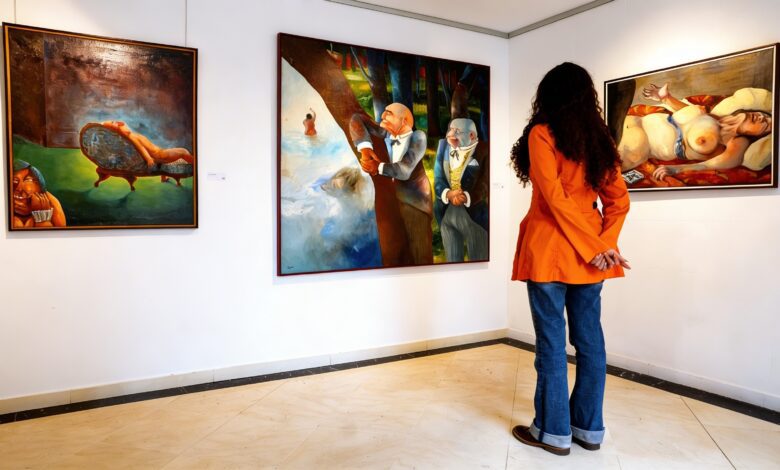
An exhibition has opened in Madrid that could change perceptions of the legacy of Spanish painting in recent decades. Works by Luis Fernando Aguirre, long overlooked by the general public, now take center stage in two of the capital’s galleries. For Spaniards, this event holds significance not only from an artistic perspective: it raises the question of how easily important names can be forgotten due to life’s circumstances and lack of recognition.
The Aguirre family spent years fighting for his works to be exhibited; after his death in 2021, they had remained in his studio. According to El Pais, the artist was known as a newspaper contributor, but his impact on art was largely overshadowed for a long time. Now, thanks to the efforts of his relatives, Aguirre’s paintings and illustrations from the 1960s to the 2000s are available for everyone to see.
Two venues — two facets of creativity
The exhibition is split between Malvin Gallery on Almadén 13 and Espacio Jovellanos, located near the Congress of Deputies. The first gallery features illustrations made for El Pais, including rare courtroom sketches from hearings where cameras were banned. Here you can also see works created for Manuel Vicent’s texts in El País Semanal. The second part of the show — 26 paintings on canvas and cardboard — traces Aguirre’s artistic evolution, from expressionism to a new figurative style.
The exhibition is open until April 24. Malvin Gallery welcomes visitors on weekdays from 17:00 to 20:00 and on Saturdays from 11:00 to 14:30. Espacio Jovellanos is open Monday to Saturday from 12:00 to 20:00. Organizers emphasize that the main goal is not to sell artworks, but to bring the artist back into the country’s cultural scene.
The artist’s path beyond boundaries
Aguirre’s life turned out such that he had to put aside his brushes for stable work and family. Despite this, his art remained relevant. In the 1960s he received a prestigious Fundación Juan March scholarship to study expressionism in Germany, which helped him develop his own style. In the 1970s his works acquired traits of the paranoid-critical movement with elements of surrealism, and in the 1980s they became part of the new wave of figurative painting.
Dogs hold a special place in his paintings, becoming a kind of symbol for the Aguirre family. At first, the artist depicted various breeds, but later focused on the boxer, the family’s own dog. This motif became a hallmark of his work, giving it a personal and recognizable touch.
Perceptual complexity and details
Aguirre’s paintings are not meant for a casual glance. They are filled with details, double images, and complex narratives, requiring careful observation and time from the viewer. According to exhibition curator Luis Feás, the artist’s works might seem challenging, especially those created after the 1970s, when explicit sexuality and elements of surrealism began to appear. However, it is precisely this multilayered quality that makes the exhibition unique for contemporary Spanish art.
The artist’s family admits that letting go of these works is not easy, but they believe the paintings should be accessible to the public, rather than gathering dust in a studio. According to russpain.com, such exhibitions are gaining popularity, as they help bring forgotten names back into the cultural spotlight.
Context and trends
In recent years, there has been growing interest in Spain for retrospectives of lesser-known artists whose works had long remained outside museum collections. Similar initiatives have already led to a reevaluation of individual artists’ contributions to the development of national art. For example, recent exhibitions in Barcelona and Valencia have also been dedicated to reviving forgotten masters. In this context, the exhibition ‘Mi perro tiene memoria’ continues the trend, allowing audiences to discover new names and view art history from a different angle. Interestingly, issues of cultural heritage preservation and its role in modern life are being discussed not only in art — for instance, a debate has recently arisen in Andalusia about reallocating funds for water supply, which also touches on issues of memory and societal values.