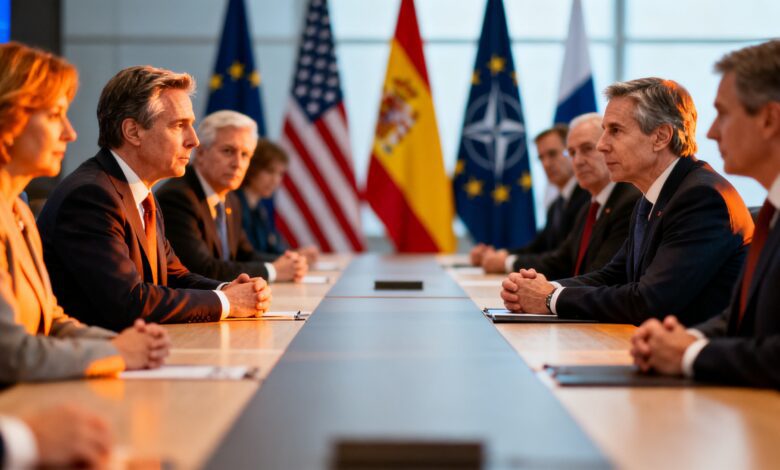
Tensions are rising in Washington between the US and its European NATO allies. According to Reuters, US Deputy Defense Secretary for Policy Elbridge Colby has drafted a plan that would tighten requirements for countries unwilling to increase their defense spending. Spain is at the center of attention: there is even discussion of temporarily limiting its participation in the alliance if Madrid does not meet Washington’s conditions.
Colby, known for his hardline stance and longstanding focus on confronting China, insists that European countries not only increase their own military budgets, but also buy more weapons from American companies. In his view, the US should concentrate its main resources on the Indo-Pacific region, where Colby believes the question of global leadership between Washington and Beijing will be decided.
Pressure on the allies
At a NATO defense ministers’ meeting in February, Colby stated bluntly that the old model, in which the US provided the main share of the alliance’s military power, no longer works. He proposed shifting to a ‘NATO 3.0’ format, in which European countries take on most of the spending and responsibility. As an argument, Colby reminded attendees that Washington cannot simultaneously maintain its previous level of military presence in Europe and effectively contain China.
In recent weeks, as Reuters notes, the Pentagon has been discussing the possibility of imposing sanctions on allies who refuse to provide bases for US operations or fail to increase their defense budgets. Spain is among the countries whose position has caused particular dissatisfaction on the American side. There are even talks behind the scenes about temporarily restricting Madrid’s participation in the alliance, although such a move is not legally possible at this time.
Spain under fire
In May last year, Colby met with Spanish Deputy Foreign Minister Diego Martinez-Belio. At the time, the American official inquired whether the recent large-scale power outage in Spain was linked to a cyberattack. The Spanish side assured that there was no threat and expressed support for the US geopolitical priorities. However, as sources note, relations between the countries have become noticeably more tense today.
Colby, author of the book “La estrategia de la negación, cómo América puede ganar a China sin guerra,” previously held high-ranking positions in the Trump administration and is considered one of the key foreign policy advisers. His approach to allies is based on a “carrot and stick” principle: the US is willing to support partners, but demands concrete steps in return.
Context for Spain
The question of Spain’s role in NATO and its relations with the US has repeatedly been the subject of discussion among experts. For example, the FAES forum in Madrid previously analyzed how pressure from Washington and internal divisions affect the country’s defense policy. You can learn more about this in the article on the risks to Spanish defense amid US criticism.
Currently, according to American officials, Spain and other European countries need to reassess their priorities and increase investments in defense. Otherwise, as the Pentagon suggests, Washington may reconsider the format of cooperation and support within the alliance.