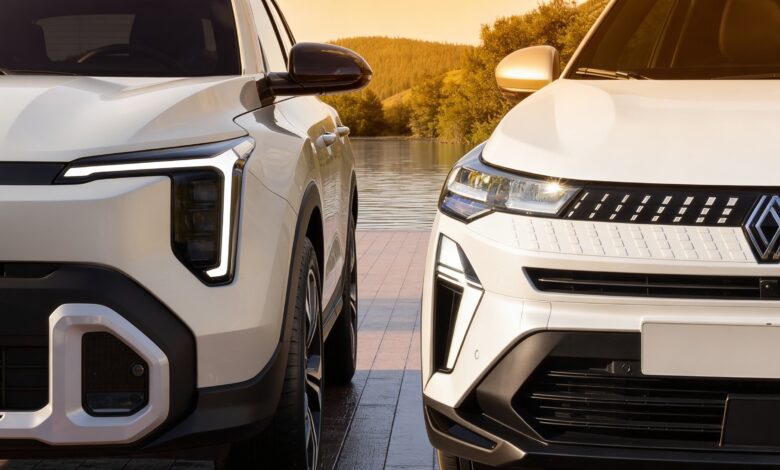
The B-SUV compact crossover segment has long been one of the key sectors of the Spanish market, where competition for buyers comes not only from European but also Asian brands. The Renault Captur and Kia Stonic are two prominent players in this category, each offering its own perspective on what the ideal first car for a new driver in Spain should be. As demands regarding environmental friendliness, practicality, and price grow ever stricter, it is models like these that define the face of the mass market.
Renault Captur: betting on versatility
The second-generation Renault Captur, after its 2020 facelift, continues to maintain its position as one of the most balanced B-SUVs in Spain. At 4.24 meters long, the model stands out not only for its fresh signature design but also for its well-organized interior space. Inside, there is a vertical openR Link multimedia system with a 10.4-inch screen based on Android Automotive 12, with Google support and wireless smartphone integration. Top versions come with a 10.25-inch digital instrument panel that can display navigation.
The Captur’s practicality is highlighted by the longitudinal adjustment of the rear seat, allowing luggage space to range from 326 to 422 liters—a figure rarely seen in this segment. According to Auto Bild, the Captur leads the Stonic in Spanish sales, trailing only the Clio in Renault’s lineup.
The Captur offers a broader range of engines than most competitors: petrol versions, micro-hybrid, full hybrid, and even an LPG option. The base ECO-G engine with 120 hp is compatible with LPG and receives an ECO environmental sticker, while the petrol TCe 115 hp does not. Higher up are the TCe 140 mild hybrid (140 hp, EDC automatic) and E-Tech full hybrid (160 hp, CVT). Trim levels — evolution, techno, and esprit Alpine — come standard with a digital instrument cluster, multimedia system, rear-view camera, climate control, and an extended set of driver assistants.
Kia Stonic: accessibility at its core
After the update, the Kia Stonic remains slightly more compact (4.16 m in length) but continues to attract urban buyers. Externally, the facelift brings the Stonic closer to Kia’s electric cars, while inside, there’s a horizontal layout of the dashboard with two screens (10.7 and 12.3 inches) and a separate climate control unit with touch controls. A key feature is the 352-liter trunk, which, although it lacks longitudinal adjustment for the rear bench, has a convenient rail-mounted cover.
The Stonic offers two petrol versions: the 1.0 T-GDI with 100 hp (without electrification) and the same engine with 115 hp paired with a 48-volt mild hybrid system, granting it the ECO sticker. Both engines are available with manual transmission, while the higher-powered version is also offered with a 7-speed DCT. The Concept, Drive, and GT-Line trims include modern driver aids: adaptive cruise control with predictive function, lane keeping, and exit warning.
Price versus space
The main argument for the Kia Stonic is its starting price: 19,090 euros versus 22,225 euros for the Captur. Even when you factor in the extra cost for the micro-hybrid (about 300 euros), the Stonic remains noticeably more affordable, which is critical for first-time car buyers. At the same time, its standard equipment is on par with competitors, while its compact size and ease of handling make the Stonic convenient for city driving and short trips outside urban areas.
Renault Captur, on the other hand, targets those seeking a bit more space and flexibility. Its trunk and modular interior are suitable for family needs and long trips. However, the micro-hybrid with 140 hp costs 24,214 euros, and the HEV hybrid version with 160 hp is priced at 27,075 euros. Notably, the base version with an ECO label is LPG, not a mild hybrid.
Market context and competitors
The B-SUV segment in Spain remains one of the most competitive, where the Captur and Stonic compete not only with each other but also with models like the Peugeot 2008, SEAT Arona, and Volkswagen T-Cross. As russpain.com notes, interest in compact crossovers is consistently high, and the choice between practicality and price is a decisive factor for many buyers. In this context, comparing the Captur and Stonic resembles a dilemma between two philosophies: maximum versatility versus smart savings. For those considering alternatives, it’s useful to look at different approaches to choosing a first car by examining other segments.
The Renault Captur and Kia Stonic offer two different responses to the Spanish market’s demand for a first car: one focuses on space and versatility, the other on price and equipment. Both options remain relevant for buyers seeking a balance between modern technology, environmental friendliness, and real-life daily needs.