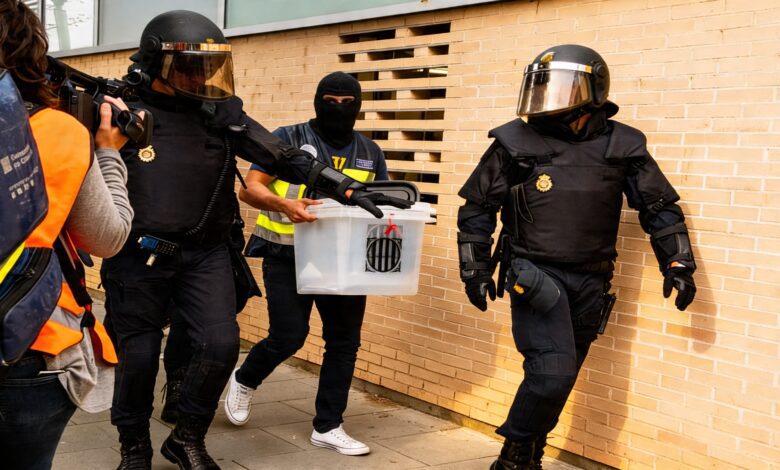
The Spanish Supreme Court’s decision on the fate of materials seized during the October 1, 2017, referendum has sent an important signal across the country. The evidence, stored for years in police archives, will now be destroyed, with only select samples remaining at the court’s disposal. For many Spaniards, this event marks a new phase in the judicial proceedings related to the Catalan independence movement.
After reviewing the appeal from the Catalan police, the panel of judges agreed to destroy ballot boxes, ballots, envelopes, and other documents seized on voting day. However, the court required that one or two items of each type of evidence be preserved and transferred to the Supreme Court for further storage. As noted by El Pais, this decision comes almost seven years after the verdict in the October 1 case, when several leaders of the Catalan movement received prison sentences.
Destruction procedure
The entire process will be supervised by a judicial administration representative, who is required to document the proceedings and produce an official report. After the destruction is complete, all remaining samples must be sent to the Supreme Court, where they will be kept in designated facilities. Materials currently stored in various police warehouses throughout Catalonia are to be centralized at the main police station in Sabadell.
To organize the transfer and destruction of evidence, the Supreme Court has submitted an official request for cooperation to the High Court of Catalonia. This measure will ensure transparency and compliance with all legal procedures. According to El Pais, the decision was signed by five out of the seven judges involved in the 1-O trial, highlighting the significance and unity of the judiciary’s position.
Historical context
The materials now set for destruction played a key role in the investigation and trial of former members of the Catalan government, including Oriol Junqueras and Carme Forcadell. These pieces of evidence formed the basis for convictions and also influenced the fate of Carles Puigdemont, who remains outside Spain and is still wanted by authorities.
The decision to dispose of the evidence is linked to the completion of the legal proceedings, and there is no longer a need to retain the large volume of material. However, the preservation of select samples will allow for future review or analysis of the events of October 1 if necessary. This approach has already sparked debate among lawyers and historians, as destroying the original documents may complicate new investigations or case reviews.
Reaction and consequences
The Supreme Court’s decision has sparked mixed reactions in society. Some believe that destroying the evidence is a logical step once the case is closed, while others worry it could make it harder to objectively assess these events in the future. Notably, similar questions regarding the preservation of evidence and transparent procedures have arisen in other high-profile cases in recent years. For instance, in the report on the distribution of elite VPP properties in Alicante issues of document control and storage were examined, which also triggered widespread public debate.
According to russpain.com, such decisions could set a precedent for other cases involving mass protests or political conflicts. The question of how long evidence should be preserved remains unanswered and calls for further discussion at the national level. Meanwhile, for many residents of Catalonia and Spain as a whole, the Supreme Court’s move marks the end of one of the most intense periods in the country’s recent history.
In recent years, Spain has repeatedly seen debates over whether to destroy or preserve materials related to high-profile court cases. For example, after the conclusion of several corruption and misconduct cases in municipalities, some documents were also destroyed by court order. In other cases, certain evidence was preserved for potential future investigations. Practice shows that the approach to storing evidence depends on the nature of the case and the level of public interest, and court decisions often become a topic of discussion among experts and citizens.