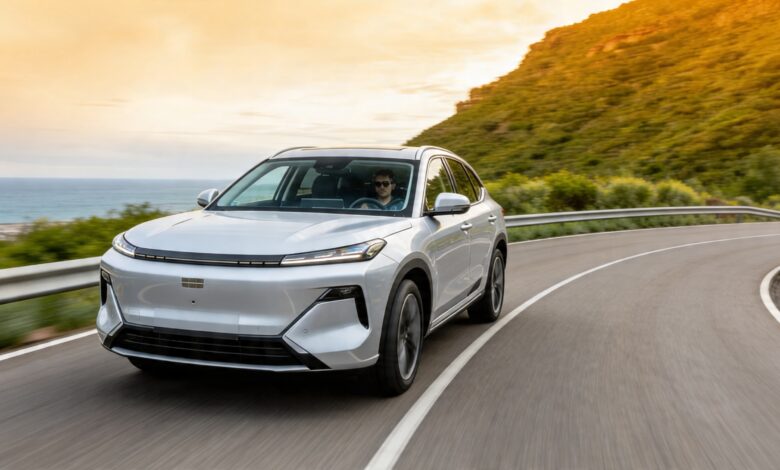
Geely once again surprises the automotive market by introducing the Galaxy Starshine 6—a sedan that goes against the trend of total electrification. Unlike most new models that bet on lithium batteries, the Chinese manufacturer focuses on methanol as an alternative fuel. For the Spanish market, where electric and hybrid vehicles are hot topics, this approach is not only unusual but potentially significant: the issues of weight and energy density have been pressing for a long time, especially in the mass segment.
Methanol vs Lithium: A Technical Debate
At the core of the Galaxy Starshine 6 concept is a hybrid architecture featuring a plug-in module and an M100 methanol tank. According to Geely, lithium batteries—despite all technological breakthroughs—remain heavy, nearly doubling the vehicle’s weight compared to methanol-powered counterparts. This affects not only the dynamics and handling but also energy consumption and chassis lifespan. The Galaxy Starshine 6 is equipped with a 1.5-liter engine producing 93 kW, running exclusively on methanol, which allows for a smaller battery and reduces the car’s overall weight.
Geely claims that methanol can store more than ten times as much energy per kilogram as a lithium battery. This allows for maintaining the usual driving range without increasing the vehicle’s weight. For the Spanish market, where charging infrastructure and the cost of owning an electric car are still pressing issues, such an alternative could attract interest—especially among those not ready to compromise for the sake of switching to pure electric vehicles.
Chinese experience and government support
Geely’s bet on methanol is not a spontaneous decision. The group’s chairman, Li Shufu, has consistently developed this direction for over two decades. In China, the state actively supports the introduction of methanol technologies: pilot projects have been running since 2012, and since 2019 there have been official guidelines for the development of methanol transport. In 2024, methanol infrastructure was included in the national green transition strategy along with charging stations for electric vehicles and hydrogen. More than 39 cities and 20 provinces are already implementing measures to support methanol cars, creating a unique environment for experimentation and scaling up new solutions.
Geely is actively testing methanol technologies not only in consumer models, but also in motorsports, where the Galaxy Starshine 6 and other prototypes are being trialed under extreme conditions. This approach allows the company to collect data on fuel reliability and efficiency, as well as to showcase the advantages of methanol in real-world scenarios.
Advantages and Limitations: The Perspective from the Spanish Market
One of the key benefits cited by Geely for methanol is the ability to use existing fuel infrastructure: refueling takes just a few minutes, and the investment required for new networks is minimal compared to fast-charging stations for electric vehicles. This is particularly relevant for Spain, where the development of charging infrastructure is uneven, and most drivers are still accustomed to quick refueling.
However, methanol also has clear drawbacks. Most methanol is produced from natural gas, raising questions about the environmental sustainability of the technology. While CO₂ emissions are lower than those from gasoline, they do not compare to the zero emissions of electric vehicles powered by renewables. Furthermore, methanol is toxic, which requires special controls during transport and storage. The only path to recognition in the European market is a shift to so-called “green” methanol, which is produced from renewable resources. Without this, the chances of the Galaxy Starshine 6 expanding beyond China, including into Spain, remain uncertain.
Context for Spain and Competition Among Alternatives
Although the Galaxy Starshine 6 has not yet been officially launched on the Spanish market, interest in alternative technologies is growing amid debates about the future of electric and hybrid vehicles. Spanish consumers are increasingly turning their attention to new solutions that can offer a balance between range, ownership costs, and environmental impact. In this context, Geely’s experience with methanol appears to be an interesting experiment that could influence the strategies of other brands. It’s no coincidence that Spain is already discussing the advantages and limitations of various types of hybrids—read more about how hybrid technologies are overtaking electric cars in the article on the shifting balance between hybrids and electric vehicles.
For reference: Geely is actively expanding its presence in Europe, but has not yet announced plans to launch the Galaxy Starshine 6 on the Spanish market. The model is positioned as a technological alternative to traditional hybrids and electric vehicles, focusing on high energy density and reduced weight. The question of methanol’s prospects in Europe remains open, but the very arrival of such solutions underscores that the fight over the future of automotive fuel is far from over.