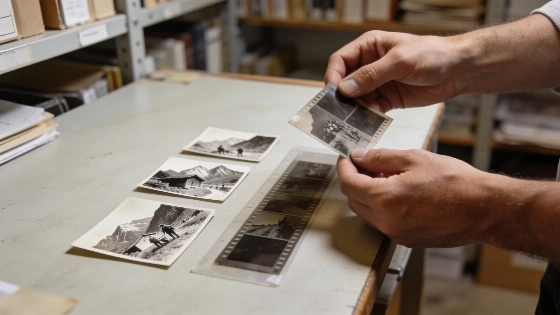
Around 2003, a selection of negatives from Piedad Isla’s archive revealed images that surprised the foundation bearing her name. RTVE’s documentary on the photographer airs Sunday at 21:30 on La 2.
Around 2003, Esteban Sáinz Vidal pulled negatives from different years in Piedad Isla’s archive and took them to the Centro de Documentación de la Imagen de Santander. The archive held more than 130,000 documents, including negatives. Isla had sorted her film rolls by assignment, village and year. The pictures that emerged carried a narrative force that surprised the Fundación Piedad Isla & Juan Torres, its vice-president, Maxi Barrios, said.
That discovery sits at the heart of Piedad Isla revelada, a documentary in the Imprescindibles programme. RTVE made the film, created by journalist Laura García Rojas and director Juan Soria. It was filmed in Cervera de Pisuerga and nearby villages. The documentary returns to the work of a photographer and ethnographer who recorded rural life in the Montaña Palentina, though she remained little known beyond the region. Isla was born in Cervera de Pisuerga on 6 September 1926. She died in Madrid on 6 November 2009.
In 1953, Isla opened her own studio in Cervera de Pisuerga. She was among the first women in the region to earn a living as an independent photographer. She worked professionally until retiring in 1992. Weddings and baptisms brought clients through the door. She also took passport photographs and studio portraits, then travelled by Vespa to document life in mountain villages. Her film rolls were carefully kept. Each shoebox carried the village and year. European funding later enabled the archive’s digitisation, and the photographs reached a wider audience in 2005. The collection also holds Super 8 films. Isla wrote scripts and narrated some of them.
One set of photographs shows the huebra, the name for communal work in Palencia province. Other frames catch nuns throwing snowballs in a school courtyard. One picture captures Roque. Another shows a transhumant shepherd, unaware of the camera. Isla recorded the rhythms of village life, from religious occasions to pastoral scenes and local customs. She called such moments the course of life, though she did not consider herself an artist.
The newly digitised images also shifted how her work was seen. In 2005, journalist Paco Alcántara and photographer Eduardo Margareto travelled to Cervera de Pisuerga to report on Isla’s ethnographic museum. They were covering the objects she had collected on Vespa journeys around the mountain region. Seeing the photographs prompted a reassessment of Isla as a photographer. The following year, Explorafoto in Salamanca mounted the first substantial retrospective. It later travelled around Castilla y León. PhotoEspaña presented another retrospective dedicated to Isla in 2020. Her archive remains in Cervera de Pisuerga, without a complete scholarly catalogue.
Recognition in her own region came when Isla was 80, three years before her death. During the centenary of her birth, Cristina García Rodero, the first Spanish woman to join Agencia Magnum, credited Isla with opening a path for other women. Juan Manuel Castro Prieto, winner of the Premio Nacional de Fotografía 2015, has praised the humanist quality of her work. Marisa Flórez has pointed to the truth in the photographs. José Manuel Navia has highlighted Isla’s unconventional life: she wore trousers and travelled by Vespa. She also became the first woman councillor in her village.
Isla worked as a photojournalist, collaborating with Agencia EFE. She also worked with Diario Palentino and El Norte de Castilla. She defended the natural environment and heritage of the Montaña Palentina.
RTVE’s documentary includes previously unpublished footage from 1975, digitised for the film, showing Isla as a young municipal councillor. A separate regional effort to bring a cultural figure into classrooms appears in a Rioja schools project about Rafael Azcona. Piedad Isla revelada airs Sunday at 21:30 on La 2.