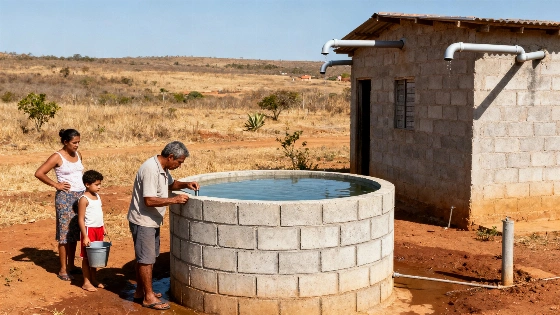
Illiterate Brazilian Creates Technology That Saved Thousands of Families from Drought. Manoel Apolônio de Carvalho, unable to read or write, invented a simple device for collecting rainwater. His creation transformed the lives of thousands of families in Brazil's arid regions and became part of a national program to combat water scarcity.
Manoel Apolonio de Carvalho, known as Nel in his native state of Bahia, grew up where water was a luxury. In the 1930s, his family of 11 lived in a village without running water: to fetch water, they had to walk kilometers in the heat, and bathing was a rare event. According to him, his mother suffered from not being able to provide her children with even the bare essentials.
In search of work, Nel went to São Paulo, where he got a job as a bricklayer's assistant. There, for the first time, he saw how cement could hold water—while building a swimming pool. This simple idea became the basis for his future invention: if a pool doesn't leak, you can build a rainwater tank to help survive a drought.
A simple solution to a complex problem
Nel Carvalho's cistern is assembled from pre-cast cement slabs installed right on site. Rainwater flows from the roof through gutters into the tank, where up to 16,000 liters can be stored—enough for a family of five to manage without outside water sources for up to eight months. Larger models for bigger households were developed as well, with capacities up to 60,000 liters.
Water from the cistern is extracted using a pump or a simple bucket on a rope. The design is simple, requires no complicated maintenance, and can be assembled even in the most remote areas where centralized water supply is unavailable.
A technology that changed lives
Nél Carvalho’s invention became the foundation for the large-scale government program 'Un Millón de Cisternas', aimed at combating chronic water shortages in the northeastern regions of Brazil. Thanks to this technology, thousands of families were able to remain in their homes and not leave their native places because of drought.
Only decades after creating his cistern did Nél receive official recognition: in 2014, the Brazilian Ministry of Rural Development awarded the civilian inventor for his contribution to solving one of the country’s major social problems. Carvalho himself admitted that he did not expect such recognition: 'I didn’t believe anyone would notice what I had done. But now I know it was important for people.'
According to Talent24h, Nél Carvalho’s technology has become an example of how a simple engineering solution can change the life of an entire region. Today, similar systems are used not only in Brazil but also in other countries with arid climates, where access to water remains a challenge for millions of people.