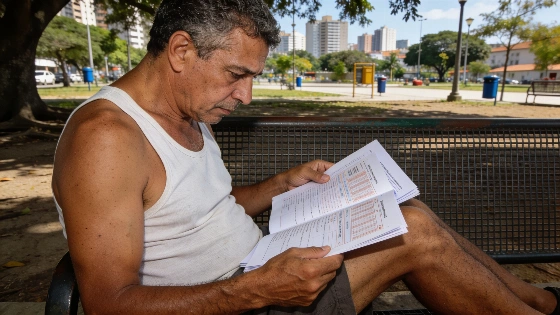
After 16 years living on the streets, Valter Fonseca dos Santos studied for just four months and achieved the highest score in a municipal exam in Patos de Minas, Brazil. His story, which resurfaced in 2026, highlights the impact of targeted social support and personal determination.
At 41, Valter Fonseca dos Santos had spent nearly half his life without a home. In November 2015, after four months of studying on park benches and in public spaces, he achieved the highest score in a competitive municipal exam for gravedigger positions in Patos de Minas, Brazil. His result—26 out of 30 points—placed him first among 22 candidates, securing one of three available jobs.
Fonseca’s journey began in Ilhéus, Bahia, where limited opportunities pushed him to seek work in Minas Gerais. He found only short-term jobs in bakeries, cleaning, gardening, and agriculture, none of which offered stability or a path out of homelessness. Despite these setbacks, he completed secondary education and eventually received support from the Centro de Referência Especializado de Assistência Social (Creas), a Brazilian public service for people facing social vulnerability.
Support and Preparation
With help from Creas director Maria Augusta de Lacerda Ferreira, Fonseca accessed previous exam materials and updated his CV. He alternated studying with cleaning work at a restaurant, often reviewing notes on public benches. Exhaustion was a constant challenge, as sleeping on the street rarely allowed for proper rest. Still, he maintained a disciplined study routine over four months, distributing his efforts throughout the day.
Before the exam, Fonseca attended five job interviews, but each time his lack of a permanent address closed doors. Creas then suggested he apply for the municipal competition, a process unique to Brazil and not directly comparable to public job exams in Spain. Fonseca chose the gravedigger position, aware of the competition and uncertain of his chances.
Exam Success and New Beginnings
The results, published on November 24, 2015, confirmed Fonseca’s achievement: 26 points out of a possible 30, or 86.7% of the maximum score. This performance secured his place at the top of the list. The initial salary was 805.18 Brazilian reais per month, with additional benefits for food, transport, and health coverage. Official documents show he was called to take up the position on March 2, 2016, and began work on April 4. The two other successful candidates joined that same month.
Fonseca’s first priority after receiving his salary was to rent a home, marking a turning point after years of instability. By December 2019, municipal records listed him as an active employee, still working as a gravedigger. There is no official information confirming his employment status beyond that date.
Social Impact and Context
Fonseca’s story resurfaced in August 2026, as Brazilian media revisited his achievement more than a decade later. The renewed attention reflects ongoing interest in stories of resilience and the role of social services in overcoming barriers to employment. While the process that enabled Fonseca’s success is specific to Brazil, it highlights broader questions about access, support, and the obstacles faced by those without stable housing.
In Spain, public job competitions operate under different rules, and targeted support for candidates in vulnerable situations varies by region. Fonseca’s experience underscores how tailored assistance—providing materials, guidance, and encouragement—can help individuals with the necessary qualifications compete on equal terms, even after years of exclusion.
As reported by Talent24h, Fonseca’s case remains a rare example of how determination, combined with institutional support, can break cycles of disadvantage. The available records suggest that, at least for several years, he was able to build a new life on the foundation of his own effort and the right help at the right moment.