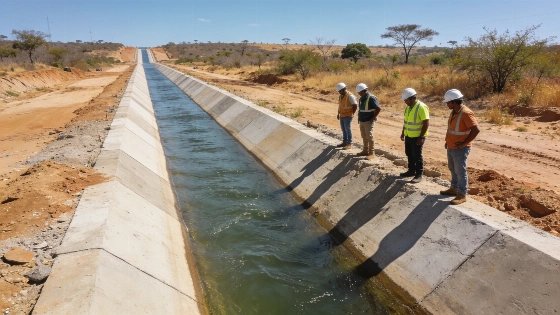
Brazil’s ambitious Cinturão das Águas do Ceará canal is now 92% finished, with water already flowing across 100 kilometres. The project aims to secure water for nearly five million people in Ceará, but full completion has been delayed to 2027.
Water from the São Francisco River now travels over 100 kilometres through the Cinturão das Águas do Ceará, marking a major milestone for one of Brazil’s largest hydraulic projects. With 92% of the 145.3-kilometre canal finished, the initiative is reshaping water security for Ceará’s drought-prone interior, though the final handover has been pushed back to 2027.
Construction began in 2013, targeting the chronic water shortages that have long affected Ceará. The canal’s design relies on gravity, using the natural slope of the land to move water from the Jati reservoir—fed by the São Francisco’s North Axis—towards the headwaters of the Cariús River. This approach eliminates the need for pumping stations, reducing both costs and energy use.
The infrastructure is divided into five sections. As of July, three lots were complete, while the fourth had reached 75%. The latest progress came with the delivery of an additional 15 kilometres in Barbalha. The canal’s maximum capacity is projected at 30 cubic metres per second, or 30,000 litres every second, making it a critical supply line for the region.
Once operational, the Cinturão das Águas will connect the São Francisco’s flow to several river systems and reservoirs, including the Salgado, Jaguaribe, and the strategic Castanhão reservoir, which supports the metropolitan area of Fortaleza. The project is expected to benefit around five million people, improving water availability in Cariri, Alto Jaguaribe, and beyond.
However, the canal is only the first phase of a much larger plan. The full vision includes nearly 1,300 kilometres of interconnected channels and branches, designed to serve up to 80% of Ceará’s territory by 2040. Most of this network will also operate by gravity, reflecting a shift towards large-scale, energy-efficient water management.
Despite its scale, the canal cannot create new water resources or guarantee rainfall. Its main function is to redistribute existing water, linking reservoirs, rivers, and supply networks. The effectiveness of the system will depend on the São Francisco’s flow, reservoir storage, and ongoing maintenance. As a result, officials stress that the project is about enhancing water security, not eliminating drought altogether.
Local adaptation remains essential. Ceará will need to combine this infrastructure with water-saving measures, local storage solutions, and agricultural adaptation. In other regions, innovative approaches—such as moisture-retaining gels for crops—are being explored to cope with dry periods. The Cinturão das Águas offers a large-scale response, but coordinated management will be key to ensuring water reaches homes, cities, and farms.
For comparison, recent research in the Amazon has highlighted how even small-scale interventions can have far-reaching impacts on regional ecosystems, as seen in studies on biodiversity loss linked to agricultural expansion in Peru and Colombia. The scale and ambition of Ceará’s canal reflect a different approach, but both underscore the complexity of managing water and land in changing climates.
According to official estimates, the total cost of the Cinturão das Águas do Ceará is now around 2.3 billion reais. Technical details and updates are available from the Ceará State Water Resources Secretariat.