Spain’s record-breaking June heat has upended old habits for keeping homes cool. AEMET now urges residents to rethink when and how they ventilate, as tropical nights mean opening windows too early can make things worse. Here’s what actually works—and when.
On June 22 and 23, 2026, Spain experienced its hottest June days since at least 1950, according to provisional data from the Agencia Estatal de Meteorología (AEMET). But it was the nights that truly stood out: temperatures in many regions failed to drop, leaving homes sweltering well past midnight and challenging the country’s traditional approach to summer ventilation.
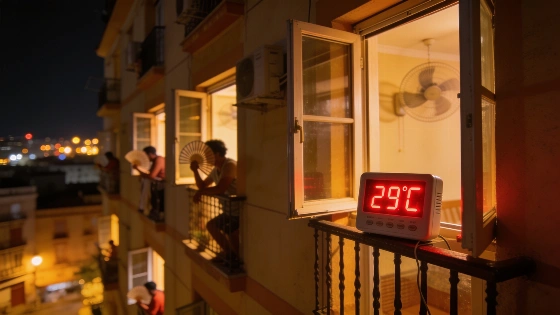
For decades, opening windows at sunset was a near-universal ritual to flush out daytime heat. This year, however, AEMET warns that such habits may now do more harm than good. The rise in so-called “tropical nights”—when temperatures never fall below 20°C—and even “equatorial nights,” with minimums above 25°C, means that outside air can remain warmer and more humid than the air indoors for much of the night. In Zarautz, a coastal town known for its mild climate, Euskalmet recorded a nighttime low of 30.4°C, with no relief until dawn.
When Ventilation Backfires
These extreme nights are no longer limited to Spain’s southern cities. AEMET notes that the number of “equatorial nights” has increased tenfold since 1984 in the country’s ten largest urban areas. In coastal zones, dense cities, and top-floor apartments, opening windows too early can actually draw in hotter, stickier air, trapping heat inside and making sleep even more difficult.
The key, experts say, is not the hour but the temperature difference. The Organization of Consumers and Users recommends waiting until the outside air is at least one or two degrees cooler than the air inside. If both are equal, ventilation will have little effect. In many places, the coolest moment may not arrive until the early morning hours—sometimes just before sunrise—rather than at sunset.
How to Ventilate Effectively
To maximize cooling, AEMET advises checking hourly forecasts to pinpoint when your area will reach its nightly minimum. Open windows only during this window, and close them again before temperatures start to rise. Cross-ventilation—opening windows on opposite sides of the home—can help move air more efficiently. Once the outside temperature climbs, close windows, blinds, and curtains to keep heat out.
Reducing indoor heat sources is equally important. Avoid using ovens, irons, or dryers during the day. While fans do not lower room temperature, they circulate air and help sweat evaporate, improving comfort. For homes that remain uncomfortably hot, Spain’s National Plan for Preventive Actions Against Excess Temperatures recommends spending time in shaded, air-conditioned, or otherwise cool spaces, and drinking water regularly—especially for older adults, children, and those with chronic illnesses.
Adapting to a New Normal
Spain’s changing climate is forcing a rethink of everyday routines. As AEMET’s data shows, the timing and method of home ventilation now depend on local conditions, not fixed schedules. Residents are encouraged to monitor both indoor and outdoor temperatures and adjust habits accordingly. For those seeking additional strategies, some have turned to methods like window coverings, though as explored in this analysis of aluminum foil’s effectiveness against heat, not all quick fixes deliver lasting results.
Ultimately, the most effective defense against nighttime heat is a combination of careful timing, smart ventilation, and minimizing indoor heat sources. As Spain faces more frequent and intense heatwaves, these adjustments are becoming essential for comfort—and, in some cases, for health.