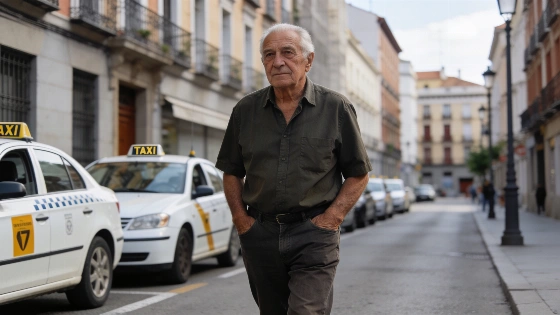
Antonio spent more than four decades navigating Madrid’s streets as a taxi driver. Now retired, he values the simple luxury of unstructured days and the freedom to choose how he spends his time—without the pressure of a work schedule.
Antonio’s days once began before sunrise, with the city of Madrid still waking up. For 44 years, he drove a taxi, often starting at seven in the morning and not finishing until eight or nine at night. Today, his routine is unrecognizable: he simply enjoys the freedom to do nothing at all.
Asked what fills his time now, Antonio’s answer is direct: “Now I dedicate myself to doing nothing.” The remark, shared during a street interview by the account @queopinanporlacalle, captures the essence of his new life. After decades of relentless work, he finally has the one thing he always lacked—time.
Long Days, Few Breaks
Antonio recalls the rhythm of his working years with clarity. Mornings began early, and after a midday pause for lunch, he would return to the driver’s seat for several more hours. The day rarely ended before nightfall. “I used to work from seven in the morning until eight or nine at night,” he says, describing a schedule that left little room for anything else.
Despite the demanding hours, Antonio never lost his fondness for driving. What changed with retirement was the sense of obligation. Now, he drives only when he wants to, with no passengers waiting and no clock to watch.
Night Shifts and Changing Priorities
In his youth, Antonio sometimes worked nights, but as the years passed, he shifted to daytime hours. He draws a sharp line between the two: “I only worked nights when I was younger, then not anymore.” His reflection—“The night is life; the day is for the workers”—reveals how his perspective evolved over time. The city at night, he suggests, belongs to those who can truly live it, while the day is reserved for those with obligations.
Antonio’s experience is not just that of an observer. He spent years navigating Madrid’s streets while most residents slept or enjoyed their leisure. Now, he walks those same streets at his own pace, free from the demands of work.
Retirement and a New Rhythm
Retirement has brought a dramatic shift. Gone are the days structured around a relentless schedule. When asked about his current routine, Antonio’s answer is as simple as it is telling: “Now I dedicate myself to doing nothing.” Behind that phrase are 44 years of contributions to Spain’s social security system—a full working life before reaching this stage of autonomy.
He hasn’t abandoned driving altogether. Antonio still enjoys getting behind the wheel, but now it’s a choice, not a necessity. The difference is subtle but profound: driving is no longer work, but a pleasure he can take or leave.
Decades of Work, Millions of Pensioners
Antonio’s 44 years of contributions reflect a long and steady career. In Spain, the number of years worked is a key factor in determining retirement eligibility, though it does not alone dictate the size of one’s pension. As of 2026, the standard retirement age is 65 for those with at least 38 years and three months of contributions; for others, it rises to 66 years and 10 months.
According to official data, in July 2026, Spain’s Social Security paid out around 6.73 million contributory retirement pensions, with an average monthly pension of €1,573.70. However, the exact amount Antonio receives is not specified, and depends on various factors beyond years worked, such as his contribution base and the circumstances of his retirement.
Freedom After the Taxi
Antonio’s story is a portrait of contrast. For decades, his life revolved around the taxi—early starts, late finishes, and little time for himself. Now, he strolls through Madrid without a schedule, no longer measuring his day by the next fare or the end of a shift.
His answer to what he does in retirement—“Now I dedicate myself to doing nothing”—is less about inactivity and more about the freedom to choose. After a lifetime of structure, Antonio finally has the autonomy to decide what each day will bring, even if that means simply enjoying the city at his own pace.