More than 330 exhibitors will gather in Barcelona in October. Live production tools will show how artificial intelligence is moving onto the factory floor, with sensors and automation in use.
Food factories that spot problems before operators do will take centre stage in Barcelona this October. Alimentaria FoodTech 2026 will bring more than 330 exhibitors from 22 countries to the Fira de Barcelona. The focus is practical: use data and automation to raise efficiency and cut waste, while improving food safety.
The 17th edition runs from 6 to 8 October in Hall 2 of the Gran Via venue. Companies will fill nearly 15,000 square metres with machinery, ingredients and technology for food and beverage production. International exhibitors make up 26% of the confirmed total, information from Fira de Barcelona and Europa Press.
Confirmed participants include MIMASA, Dordal, Handtmann, Weber, Vaessen Schoemaker, Hiperbaric, ULMA, Tetra Pak, Roser Group, CSB System, Brenntag, Jarvis, Midera, Sick, Impag Iberia and Bizerba.
The fair is divided into six areas: SmartAgro, Cambio, Ingredientes, Empaquetado, Digitalización y Automatización, and Seguridad alimentaria. Refrigeration, logistics and industrial services support the wider programme.
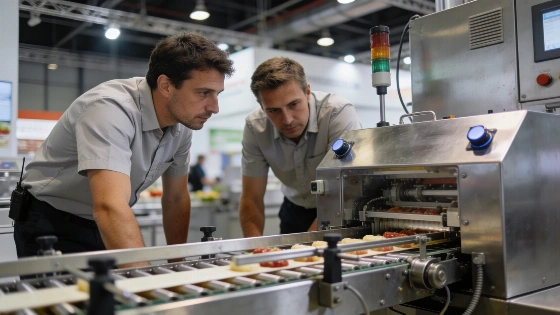
This edition shifts attention from standalone machines to connected production. Sensors collect information on the factory floor, while data platforms sort it. Artificial intelligence can then spot patterns and recommend action, or help an operator decide what to do. The official Alimentaria FoodTech programme links this approach to greater efficiency and less waste, along with stronger food safety.
La Vanguardia reports that the technology can optimise processes, anticipate incidents and make better use of large volumes of industrial data. Visitors will see the technology at work, not only in presentations. SOMENGIL's MultiWasher combines washing and disinfection with drying in one cycle, then records each operation digitally. TRAZAPACK will show +ti K, which prints directly on products such as biscuits and wafers using food-grade colourants.
The organisers position the event as a platform for the full foodtech value chain, covering machinery and ingredients alongside packaging, digitalisation and food safety. Kersia has also publicly confirmed its participation in Barcelona from 6 to 8 October 2026.
Other exhibits address points where production can lose time or compromise safety. LOMATEC Soluciones will present the METRON 07 CI DS metal detector, designed for products that can confuse conventional systems, including meat, dairy goods, bakery products and prepared meals. CSB-System's CSB Eyedentifier uses image recognition with AI to identify raw materials and products from goods reception through packaging.
OSG Foods will bring the FLW linear weigher. It can be configured for up to six lines and reach 72 weighings per minute with sticky or difficult-to-handle products.
These tools are built for existing production lines. They support cleaning verification and quality control, as well as identification and faster handling.
Food safety also features on the programme. The event will present findings from the second AECOC Shopperview Barometer on how households handle, store and prepare food, bringing factory controls closer to the final stage before consumption.
The previous edition exceeded 370 exhibitors and drew more than 15,800 visitors from 30 countries. Organisers want to match or exceed that figure in 2026. They will also present more than 140 experts and 60 FoodTech Innovarena sessions, alongside a Startup Corner with 38 Spanish companies. The figure of more than 140 experts appears in the official Fira de Barcelona announcement and in Europa Press.
The startups cover AI and alternative proteins, as well as sustainability, new packaging materials and by-product recovery. Their test is straightforward: a solution must address a real production problem, connect with existing systems and show measurable efficiency and ability to recover, not rely on slogans.
The value will be judged inside operating plants. Unlike the international cultural campaign discussed in this earlier report, this event is built around factory performance.
Alimentaria FoodTech 2026 is less about fashionable technology than daily use. Its automation and AI, alongside safety equipment and startup solutions, point to where food manufacturers may place their next investment. The demand is simple: do more with less. That will require systems that work together and deliver measurable gains, with fewer failures across the production chain.