A vast brewery complex discovered in Abydos, southern Egypt, has revealed production capacities far beyond initial estimates. New excavations suggest the site could brew up to 50,000 liters at once, offering fresh insight into early state rituals and organization.
In the desert near Abydos, southern Egypt, archaeologists have identified what may be the oldest large-scale brewery ever found. Originally announced in 2021 with an estimated capacity of 22,000 liters per batch, the site has since revealed even greater production potential as new excavations unfolded.
The discovery, led by a team from Princeton University and the Egyptian Ministry of Tourism and Antiquities, dates the brewery to around 3000 BCE, during the formation of the pharaonic state. Early calculations suggested the facility could supply daily beer rations for over 8,800 workers, but subsequent digs in 2022 uncovered structures that doubled the estimated output.
Unprecedented Scale
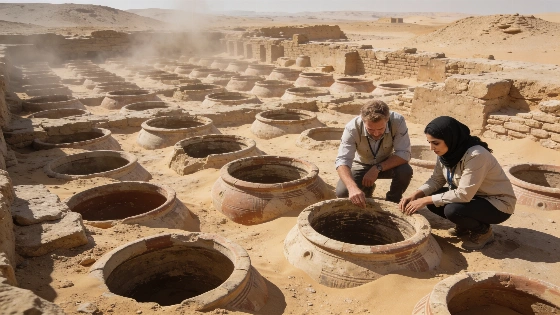
Initial research identified eight parallel buildings, each about 20 meters long, housing rows of massive ceramic vats supported by mud brick. This configuration already set the brewery apart from any previously known Egyptian beer production sites. However, the 2022 campaign revealed even larger units—over 35 meters in length and with more than 80 vat placements per structure. If all eight buildings matched these dimensions, the total capacity could approach 50,000 liters per batch, a figure that dwarfs earlier projections and highlights the industrial scale of the operation.
These findings suggest a highly organized production process, with agricultural supply chains, fuel management, and a sizable workforce. Only the subterranean portions of the complex remain, but construction details indicate the spaces were once covered, with open areas between buildings for filling, heating, and emptying the vats.
How Ancient Beer Was Made
The brewing process involved slowly heating a thick mixture of grain and water in the vats. After cooking, the mash was strained and left to ferment, producing beer. Archaeologists found dark, vitrified residues at the bottom of several vessels, likely remnants of ancient mashing. Small wall openings allowed for fuel to be added and air to circulate, and traces of wood charcoal were found nearby.
The scale and sophistication of the site point to a centralized, state-controlled operation. While only the lower parts of the buildings survive, the layout and preserved features offer a rare glimpse into early Egyptian industrial organization.
Ritual Purpose Near Royal Tombs
The brewery's location is significant: it sits close to the royal necropolis of Abydos, where Egypt's first dynasties built their tombs and cult enclosures. This proximity supports the theory that the beer produced here was intended for funerary rituals honoring the earliest kings. Excavations in the area have uncovered large deposits of beer jars used as offerings, and researchers believe the brewery supplied these ceremonies, helping to sustain the symbolic presence of deceased monarchs.
So far, there is no evidence of mass consumption elsewhere in Abydos, reinforcing the idea that the brewery's main function was ritual. Ongoing studies include chemical analysis, radiocarbon dating, and detailed examination of the ceramics to clarify the site's role.
Rediscovery After a Century
The complex was not unknown to early archaeologists. In 1911–1912, British archaeologist T. Eric Peet documented the structures but misidentified them as grain-drying ovens. Their exact location was lost for over a century, until recent advances in the study of ancient Egyptian brewing at sites like Hierakonpolis and Tell el-Farkha prompted a fresh investigation. These earlier sites showed smaller-scale beer production, but nothing approaching the scale of Abydos.
Between 2018 and 2021, Matthew Adams and Deborah Vischak, working with Egyptian specialists and the Ministry of Tourism and Antiquities, relocated and began systematic study of the site. Their work continues as part of a broader project on early Egyptian state formation and industrial production. The primary documentation is available through the Abydos Archaeological Project.
The scale of the Abydos brewery stands out even among other large-scale provisions in ancient societies. For comparison, a Spanish court recently ruled on a case involving a 10,000-liter fuel bonus for a retiree, highlighting how the logistics of mass supply—whether beer or fuel—have long played a role in shaping labor and ritual. Details of that case can be found in this report on a Spanish court's decision regarding fuel bonuses.
As research continues, the Abydos brewery offers a rare window into the economic and ceremonial priorities of Egypt's earliest rulers, revealing how large-scale production supported both daily life and the enduring power of the pharaohs.