Three prehistoric stelae unearthed in Huelva have finally clarified a century-old mystery. Their precise placement links them to both ancient burials and a long-lost road, reshaping what we know about Iberian funerary and territorial practices.
Archaeologists have finally solved a puzzle that has lingered for generations: why so many prehistoric stelae are scattered across southwestern Iberia, and what they were meant to do. The answer came from Las Capellanías in Cañaveral de León, Huelva, where three ancient stones were found not as random artifacts, but as markers set into the landscape with purpose.
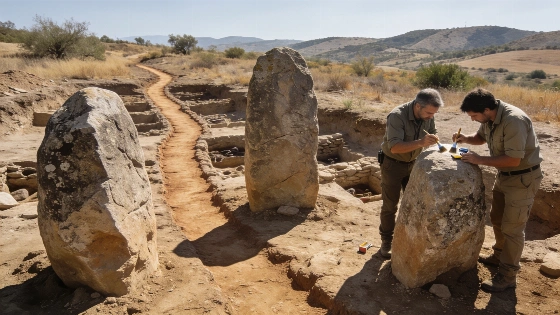
Unlike most stelae, which often turn up far from their original sites, these three were discovered in direct connection with burial structures and an old pathway. Each stone was deliberately placed—one beneath the ancient road, another upside down in a burial mound at the road’s edge, and the third partly covering a tomb just south of the path. This arrangement allowed researchers to show, more clearly than before, that these monuments marked both the presence of the dead and the movement of the living through the land.
"The Las Capellanías site revealed 18 funerary structures, of which eight were fully excavated, providing an unusually complete archaeological context for the stelae."
Antiquity
This breakthrough followed years of fieldwork. The first stone was found by chance in 2018, but it took systematic surveys and major digs in 2022 and 2023 to reveal the full story. Archaeologists from universities in Seville, Durham, Southampton, Huelva, and Gothenburg mapped 18 funerary structures across 1,250 square meters. Eight tombs were fully excavated, and the three stelae were each found in strikingly intentional positions along the ancient route.
The pattern is clear: the stones’ alignment with both graves and the road suggests they served a double purpose—memorializing the dead and guiding or warning travelers. The road itself was not a temporary track. Its course matches a medieval route described by Al-Idrisi, connecting Seville and Badajoz, and likely functioned as a main artery as far back as the second millennium BCE.
Artifacts from the site add more detail. Alongside the stelae, archaeologists found handmade ceramics, Phoenician-style wheel-thrown vessels, fibulae, belt fittings, a silver earring, glass and carnelian beads, grooming tools, and an iron knife. Cremated human remains—about 2.5 kilograms in total—represent at least 14 people, though poor bone preservation means their identities remain unknown.
"The research team linked the ancient road at Las Capellanías to a route described by the medieval geographer Al-Idrisi, suggesting that this communication corridor may have been in use since the second millennium BCE."
Antiquity
The carvings on the stones challenge old ideas. One stela fits the so-called "warrior" type, but the others mix features—diadems, weapons, and even male genitalia—blurring the usual gender categories. The University of Seville team points out that this complexity undermines the simple division of stelae into male and female types, hinting at a more flexible symbolic language in prehistoric Iberia.
Las Capellanías is unusual because so many other stelae were moved or looted before anyone could record their original setting. Here, the context is intact, offering rare evidence that these stones were not just grave markers but also territorial signs. Still, the researchers caution that not every stela across the peninsula served the same role. Many remain without secure context and may have been reused or reinterpreted over time.
The necropolis itself shows a layered history. Tombs date from the Bronze Age (2200–1550 BCE) to later cremation burials, with most cremated remains from between 800 and 550 BCE. Artifacts from the site point to connections across the Guadalquivir, Guadiana, and Tagus river basins, showing the region’s role as a crossroads for people and goods.
While the findings at Las Capellanías do not explain every Iberian stela, they offer the clearest evidence so far that, at least here, these stones anchored both memory and movement. The research, published in Antiquity, sets a new standard for how archaeological context can change our understanding of ancient monuments. It also echoes a lesson seen in other fields: the placement and function of a project or artifact only make sense in relation to its environment.
What comes out of Huelva is more than a local discovery. When stones are left where they were meant to stand, they speak with a clarity that centuries of displacement have nearly erased. The lesson is simple: in archaeology, context is not a luxury—it is essential. The Las Capellanías find is a rare win for careful, methodical science, and a reminder that the landscape itself often tells the best story.