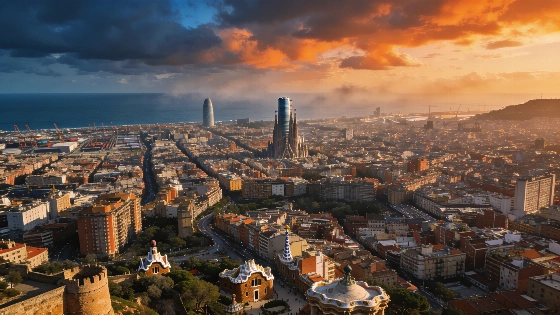
Barcelona has launched the next phase of Montjuïc’s Fira redevelopment. Demolition and construction are underway to meet the 2029 centenary deadline. The project includes a new multifunctional venue, restored historic buildings, and hundreds of protected homes.
Barcelona has begun a sweeping redevelopment of the Fira de Montjuïc fairgrounds, aiming to complete the transformation before the 100th anniversary of the 1929 International Exposition. Demolition work started this week on the Palacios de Congresos and Palacio 4, clearing the way for a new multifunctional venue that will anchor the site’s future.
The overhaul is designed to modernize the historic exhibition area while preserving key architectural elements. The Alfons XIII pavilion is being restored to house the future Palacio de Congresos de Barcelona, maintaining the original structure by Josep Puig i Cadafalch. Meanwhile, the Palacio del Vestido, facing Plaza Espanya, is set to become a new innovation and economic activity center, with its iconic colonnade and main façade by Josep Maria Jujol retained as a public gateway.
City and regional officials have emphasized that the project will not disrupt ongoing fairs or exhibitions, thanks to expanded facilities at L’Hospitalet. The Generalitat’s Economy and Finance Minister, Alícia Romero, highlighted the coordinated approach and the commitment to keeping Montjuïc as an urban fairground, while Barcelona’s mayor, Jaume Collboni, pointed to the broader impact: the creation of 548 new protected homes, a new health center (CAP), and a sports complex between Avenida María Cristina and Calle de Lleida. These additions will form the core of a new residential neighborhood in Poble-Sec, with some elements scheduled for completion after 2029.
Construction logistics are already visible on site. A 200-ton crane with a 60-meter arm—one of the largest in Europe—has been deployed to facilitate demolition and extend Calle Guardia Urbana to Avenida del Paral·lel. The new multifunctional palace, designed by Smiljan Radić (recent Pritzker Prize winner), Miquel Mariné Núñez, Beatriz Borque, and César Rueda Bonet, will cover 20,500 square meters over two floors. The architects plan to reuse much of the concrete from the demolished buildings, and the structure will feature a lightweight metal frame and a landscaped walkway along Avenida Maria Cristina for better integration with the urban environment.
Work on the Alfons XIII pavilion is progressing, with asbestos removal underway and major construction set to begin in September. The redesign, led by Forgas Arquitectes, Archambac (Arquitectura Sideral), and Álvaro Alejandro Fernández, will introduce new spaces, a 6,670-square-meter garden courtyard, and a 2,025-seat auditorium, with access from Plaza de Carles Buïgas.
The Palacio del Vestido’s transformation, managed by Bjarke Ingels Group and MIAS Arquitectura, will create a flexible, three-story “Z”-shaped building surrounded by public gardens. The project also includes a 1,100-square-meter multipurpose community facility to expand neighborhood amenities for Font de la Guatlla and Hostafrancs.
The first phase of the redevelopment carries a €290 million price tag: €250 million for the new multifunctional palace and Alfons XIII pavilion, and €40 million for the Palacio del Vestido. All works are scheduled for completion by 2029, a timeline both Collboni and Romero insist will be met. A second phase, planned for 2030–2035, will focus on renovating the Palacio de las Comunicaciones and Palacio de la Metalurgia.
Barcelona’s approach to urban renewal at Montjuïc echoes the city’s tradition of major transformations, following the 1929 Exposition and the 1992 Olympics. The current project stands out for its blend of heritage preservation, new public infrastructure, and housing. For context, the city’s evolving governance and urban priorities were recently highlighted when David Bondia was reappointed as Barcelona’s ombudsman amid political debate.
Montjuïc’s redevelopment is part of a broader trend in Spanish cities to balance historic preservation with modern needs. The Fira de Barcelona is a key economic driver, hosting major international events and exhibitions. The planned residential and community facilities are expected to address local housing shortages and improve public services in the area. As the 2029 deadline approaches, the project’s progress will be closely watched by residents, businesses, and the events industry alike.