CaixaBank, Bankinter and Unicaja have opened Bizum Pay to more customers. Nearly 20 million people can now use it in physical shops, with 1.6 million businesses connected to the service.
Bizum Pay is moving beyond its trial and into everyday shopping in Spain. CaixaBank, Bankinter and Unicaja have opened in-store payments to almost 20 million users. That is around 60% of Bizum's customer base. It gives the platform a bigger chance to challenge Apple Pay and Google Pay at the checkout. Spanish financial and business outlets, including Europa Press and El Economista, have reported the same milestone.
CaixaBank customers have seen the biggest change so far. The bank has enabled Bizum Pay for 100% of its clients. It says more than 517,000 payment terminals are ready to accept the service. Bankinter has also opened it to its full customer base. Unicaja has activated it for people who already use Bizum.
Unicaja has connected Bizum Pay’s in-store payments as part of its 2025–2027 strategy, pointing to continued expansion among Spain’s major retail banks.
Customers of Banco Sabadell, Abanca and Caja Rural entities already had access to the digital wallet.
The physical rollout began on 18 May 2026. At first, only selected customers at certain banks could pay with Bizum Pay, and relatively few shops had compatible terminals. Four months later, more banks, customers and businesses have joined. September has become the point at which the sector is speeding up the rollout.
For merchants, the technical work is fairly simple. In most cases, the existing payment terminal does not need to be replaced. The business only has to ask its bank or payment provider to activate the service and then keep using the same device.
The six banking groups reported as already offering access include CaixaBank, Bankinter, Unicaja, Sabadell, Abanca and Caja Rural entities. This broadens the rollout beyond the three banks highlighted in the initial announcement.
The service is still not available everywhere.
A payment works only when both sides are ready. The customer's bank must have enabled in-store payments. The merchant's terminal must support Bizum too. That is why the number of users and the number of compatible terminals have not grown at exactly the same pace during the first months.
Bizum says more than 1.6 million establishments can now accept the service. That is roughly three out of every four bank terminals in Spain, or 75%. More than 25 large retail chains are also adding it at different stages. Bizum wants practically all of its users to be able to pay this way by the end of the year.
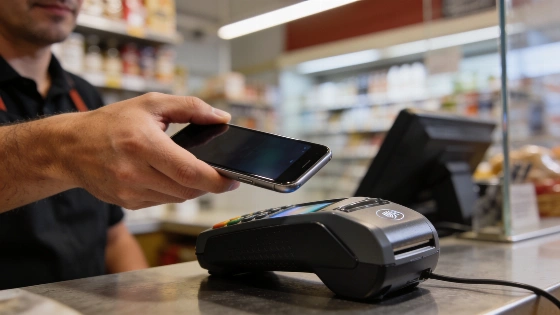
The process is similar to other digital wallets. The customer unlocks the phone and holds it near the terminal using NFC. After the customer selects Bizum, the money leaves the linked bank account and reaches the merchant through an immediate transfer instead of a card network. Bizum says the funds move within seconds.
The wallet can also hold debit and credit cards. Users can choose a backup payment method. If a shop does not yet accept Bizum, the purchase can go through that alternative without leaving the wallet or starting again.
That gives banks more than another customer service. Around thirty Spanish financial institutions own Bizum. Its move into physical shops puts those banks into a payments business that international card networks have long dominated. Payment is free for the customer. The merchant pays a small commission, as with card transactions.
The first usage figures are still modest. Bizum says customers who already use the service in shops make an average of three payments a week. The company has not disclosed the total number of purchases since May. CaixaBank has reported nearly 25,000 payments worth more than €400,000 since its pilot began in mid-July. That works out at about €16 per transaction.
Bizum is also building a European route for the service. Spanish users can already send and receive instant payments with users of equivalent systems in Italy, Portugal and Andorra. The roadmap calls for this interoperability to reach online commerce and physical shops in 2027. Spanish users would then be able to pay with Bizum in other European countries.
The service has moved quickly from peer-to-peer transfers into retail payments. Wider access alone will not guarantee that people keep using it. Bizum now has the banks and terminal coverage needed to make regular shop payments possible. The real test is whether customers keep the habit after the launch period.
For Spain's banks, this is a direct attempt to capture part of the transaction revenue controlled by card networks. The expansion is a real commercial shift, even if its success will be measured by purchases rather than registered access.