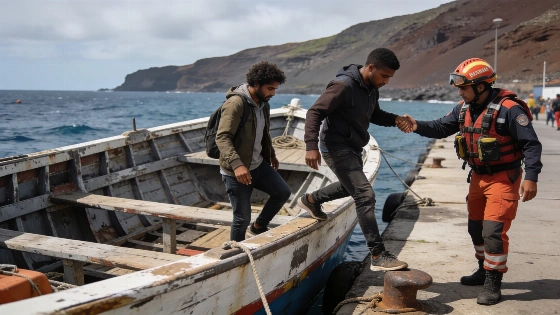
Nine boats brought 1,107 people to the Canary Islands since Friday. Sunday saw 668 arrivals and six people taken to hospital, as arrivals climbed after a steep early-year fall.
Among those who reached the islands were 35 minors and 32 women. Six people were taken to hospital; one was in critical condition.
Sunday brought 668 arrivals. People reached El Hierro and Gran Canaria, with Lanzarote also among the destinations. The weekend’s scale comes amid a marked late-summer acceleration, although the year-to-date total remains below the same period in 2025.
By September 30, 2026, 95 vessels had brought 7,133 people to the Canary Islands by sea. In the same period of 2025, 211 boats carried 12,848 people.
Accounts given to emergency services and reported by Efe say three boats that reached El Hierro had departed from Gambia or Senegal. The vessel that arrived on Friday carried 123 people and had left Barra in Gambia, making an eight-day crossing.
On Sunday, a boat carrying 220 people arrived after setting out from Niodior in Senegal. It had spent six days at sea. Another boat, with 136 people aboard, had sailed for seven days from Brufut in Gambia. Authorities have not disclosed departure points for the other arrivals.
Interior Ministry figures show that 7,133 people reached the islands by sea between January and September, 44.5% fewer than in the same period of 2025. The difference was 5,715 people. The ministry recorded 95 vessels in 2026, against 211 boats and 12,848 arrivals in 2025.
That year-to-date comparison hides a sharp shift. Arrivals in the first quarter were down 82.6%. From March to June, they rose 9. In the third quarter, arrivals more than doubled, reaching 3,425 from 1,527.
On October 12, Canary Islands president Fernando Clavijo said more than 3,800 people had arrived in a little over a month and a half since the start of September. He warned that the islands could face a return to the scale of 2024, when around 47,000 people arrived.
September drove much of the late-quarter rise. The month recorded 1,970 arrivals, about four times August’s 488. Europa Press reported a 172% increase compared with September 2025; the figures cited here put the rise at 173%. El Hierro and Lanzarote were among the main destinations.
In late September, Canary Islands president Fernando Clavijo called the increase foreseeable. He linked it to the EU Migration and Asylum Pact, which entered into force in June, and said attention shifting towards the Mediterranean after the Ceuta crisis was leaving the Atlantic route less protected.
In October, Clavijo also pointed to events in Ceuta and the redeployment of Moroccan forces to the north. He said these developments could add pressure to the Atlantic route. Those are Clavijo’s assessments, not causes established by official arrival statistics. He has also accused the central government of failing to respond to the renewed increase. The figures show arrivals climbing sharply from the first quarter, while the cumulative total remains below last year’s.
The route is traditionally busier from September through autumn. North-east trade winds over the Atlantic weaken during that period, and sea conditions become less rough for precarious boats departing West Africa.
Organisations involved in reception say their teams have remained in place. They describe the pattern of rises and falls as familiar, rather than an emergency.