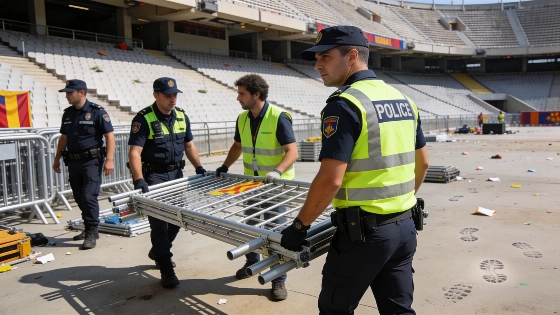
The Generalitat has published a detailed breakdown of the €3.3 million spent on Pope León XIV’s visit to Catalonia. Security, transport, gifts, and promotion accounted for the bulk of the costs. The figures highlight the scale of public funding involved.
The Generalitat has released the full financial report on the visit of Pope León XIV to Catalonia, confirming a total public expenditure of €3.3 million. The disclosure, which comes after internal review by the Justice Department, details how the regional government allocated funds across security, transport, hospitality, and promotional activities during the pontiff’s three-day stay in June.
Of the total, €2.8 million was granted as a direct subsidy to the Archdiocese of Barcelona, approved at the last Consell Executiu meeting before the summer break. This major outlay was intended to cover the organization of the papal vigil at the Estadio Olímpico and the full operation of the international press center at Fira de Barcelona. The funds were sourced from the region’s tourist tax and processed through the Department of Enterprise, following a tripartite agreement signed in May between the Generalitat, Barcelona City Council, and the Archdiocese.
Additional expenses of €445,000 were drawn from the Generalitat’s own budget, covering reinforced transport, extra security, and the dissemination of the event. The Justice Department’s breakdown, obtained under transparency legislation, reveals granular details: €49,536 was spent on security, including coach rentals for police deployment, bottled water, and portable coolers for officers. The Interior Department’s figure may rise, as overtime for Mossos d’Esquadra during the visit is still being calculated.
Transport-related costs included €27,002 for service and surveillance enhancements, with a notable €6,923 allocated to the rack railway for the Pope’s visit to Montserrat Abbey and €16,355 for additional station staff and train drivers. The Department of Presidency invested €351,000 in the institutional campaign “Catalunya, terra de trobada,” leveraging the event’s international exposure. The Catalan Tourism Agency spent €11,620 on marketing to foreign media, and a reception for international journalists cost €2,750.
Among the more symbolic expenses, three official gifts for Pope León XIV totaled €1,794: a replica of the “Las Homilías de Organyà” book, a reproduction of the Ivory Girl from the National Archaeological Museum of Tarragona, and a third item provided by the Justice Department. Floral arrangements for the Pope’s meeting with inmates at Brians I prison cost €791, while staff overtime for that event reached €4,880.
The financial approach in Catalonia contrasts with other Spanish regions. For example, the Canary Islands provided two direct subsidies of €1 million each to local dioceses, while Madrid offered venues and services without publishing a cost estimate. According to the Episcopal Conference, about one-fifth of the total cost of the Pope’s visit to Spain was covered by public administrations. The Catalan budget for the event increased several times, from an initial €1.6 million to €2.3 million, and finally to €2.8 million, with the final €445,000 coming from non-tourist tax sources.
For context, large-scale religious and state visits in Spain often involve significant public spending, with costs varying widely depending on the region’s approach to subsidies, logistics, and security. The transparency around the Pope’s visit in Catalonia stands out, as not all regions publish such detailed breakdowns. In a related example of public funding for major events, a recent lottery win in Cantabria also drew attention to the role of public money in local celebrations and infrastructure.
The Generalitat’s publication of these figures provides rare insight into the financial mechanics behind high-profile international visits, highlighting both the logistical complexity and the public accountability involved in hosting such events.