Hundreds of migrant minors in Ceuta face legal uncertainty and lack of protection. Political disputes and rapid returns raise concerns over Spain’s compliance with child rights. NGOs warn of serious risks for vulnerable children.
Spain’s handling of unaccompanied migrant minors in Ceuta has come under renewed scrutiny as legal experts and NGOs question the government’s adherence to established child protection protocols. Lourdes Reyzábal, president of Fundación Raíces, which has supported over 5,000 children without family protection in Spain, has openly challenged the official narrative surrounding the recent influx of minors from Morocco. She argues that many children were drawn to Ceuta by the perception of an open border, a message that spread rapidly on social media and, according to some accounts, was even encouraged by Moroccan police.
Reyzábal points to a pattern seen in previous migration waves, where thousands of minors—some fleeing conflict, forced marriages, or persecution—risked their lives to reach Spanish territory. However, she stresses that this time, a significant number of children had not initially planned to migrate but were swept up in the mass movement triggered by the sudden opening of the border. She dismisses claims that organized crime networks were responsible for the surge, stating that “nobody would pay a mafia to enter through an open door.”
Legal procedures for the repatriation of minors are clearly defined in Spanish law, requiring thorough assessment of each child’s best interests, proper identification, and guaranteed access to legal counsel and interpreters. Yet, Reyzábal and other observers report that these safeguards have not always been respected. She describes scenes of minors being transported by military and local police to the border and alleges that some were returned to Morocco without individual evaluation or legal guarantees, echoing concerns raised during the 2021 crisis. The Spanish Supreme Court has ruled that summary returns are not legally permissible for minors, and the Constitutional Court demands individualized assessments.
Political divisions have further complicated the situation. Right-wing parties, including Vox, have linked the arrivals to broader debates on immigration policy and have called for the immediate return of all unaccompanied minors, often using inflammatory language. Coalition agreements between the PP and Vox in several regions include commitments to refuse the relocation of these children, raising fears among NGOs of a coordinated boycott of the national child protection system. Reyzábal warns that such positions undermine Spain’s obligations under the UN Convention on the Rights of the Child and risk leaving vulnerable minors without support or shelter.
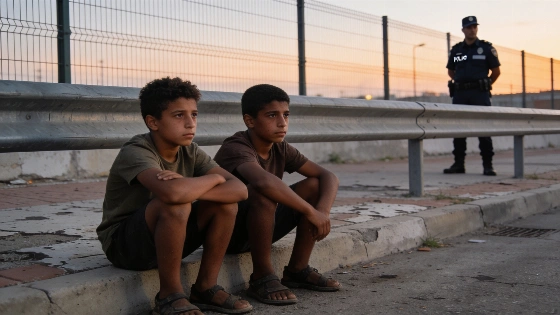
Hundreds of children remain outside the official reception system in Ceuta, sleeping rough or hiding in fear of forced return. Some have reportedly been repatriated against their will and have described experiencing violence upon their return to Moroccan authorities. Reyzábal emphasizes that family reunification should only occur when it is safe and voluntary, and that returning children to situations where their rights may be violated is unacceptable under Spanish and international law.
The debate has been further inflamed by public statements from political leaders, with some accusing NGOs of collaborating with criminal networks and celebrating the suspension of funding for organizations assisting migrants. Reyzábal notes that Fundación Raíces has faced threats from far-right groups and pressure from certain authorities, but maintains that the courts have consistently rejected attempts to discredit their work.
Comparisons have been drawn to the EU’s response to similar migration crises, such as the situation on the Belarusian border, where the use of migrants as a political tool was widely condemned. Reyzábal observes that European migration policy has become increasingly restrictive, with human rights concerns often sidelined in favor of border control. Despite recent gestures of solidarity in the Spanish parliament, she sees deep contradictions in the political discourse on migration and child protection.
Many of the minors assisted by Fundación Raíces over the past three decades have managed to build stable lives in Spain, despite the trauma and hardship they endured. Their experiences highlight both the resilience of young migrants and the ongoing challenges facing Spain’s child protection system. For further context on the political fallout from the Ceuta migration crisis, see this analysis of ministerial hearings and opposition demands: government response to the Ceuta crisis.
Spain’s approach to unaccompanied migrant minors remains a contentious issue, with legal, humanitarian, and political dimensions intersecting in Ceuta. The outcome of this debate will have lasting implications for the country’s reputation and its obligations to protect vulnerable children under both national and international law.