Residents have brought a replica of Ceuta's beach settlements to the Delegation of the Government. They want protection for children and an end to weeks of uncertainty.
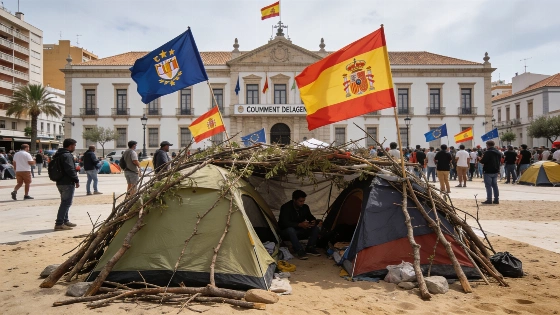
Residents of Ceuta have brought a small version of the El Trampolín settlement to the doors of the Delegation of the Government. Tents, branches and makeshift structures now fill part of plaza de los Reyes. The display is a direct protest against the camps along the coastline.
The demonstration was peaceful, but the organisers say they will keep mobilising until the situation changes.
The replica was built to make the dispute impossible to ignore. Neighbours did not limit their protest to speeches and banners. They recreated the physical conditions they say have disrupted life around the beaches and affected families across the city.
On 18 September 2026, Spanish authorities began an operation to move migrants from Ceuta’s El Trampolín and Benítez beaches. Reuters reported that a temporary facility with capacity for about 1,700 people had been set up at the port alongside the operation.
The action follows the arrival of thousands of immigrants that began on 30 July. Residents say the effects have continued for weeks. They reject the idea that illegal settlements should become part of daily life in Ceuta.
The scale of the crisis remains disputed. Depending on the date and source, different reports estimate that between 3,000 and nearly 10,000 people were outside the regular accommodation system.
Numerous immigrants remain settled illegally at El Trampolín and Benítez beaches. Some people were moved to a camp near the port. Others returned to the shoreline after the facility ran out of space.
Euronews reported that more than 2,000 people were again left on the beaches after the new site reached capacity. The move has left the coastal settlements in place instead of solving the problem.
The Foro Ciudadano de Ayuda a Ceuta y Melilla said the protest was about children's rights in Ceuta and the city's Spanish identity. Participants demanded more protection for minors, older people and dependent residents.
They also called for children to attend school, use parks, practise sport and walk through the streets without their families feeling afraid.
The dispute has also reached the courts. Several media reports said that a Spanish court temporarily suspended plans to open another temporary migrant camp near the port, amid protests from residents and criticism from a police union.
According to El Pueblo de Ceuta, the organisers presented their demands as an issue beyond party politics. They said that what residents see as abnormal must not be accepted as normal.
Spanish and Ceuta flags were visible at the demonstration. Messages included «Ceuta no se vende», «Ceuta se defiende» and «Un caballa nunca se rinde». Some participants again called for the resignation of the Government delegate.
The pressure continued after the gathering ended. Several neighbours stayed overnight beside the tents outside the Delegation. They intend to keep the replica in place.
Yolanda Carrera told El Faro de Ceuta that the display was meant to show the delegate what life is like at El Trampolín. That includes the noise and the makeshift conditions.
The protest also follows the space crisis described in an earlier report about the port camp and the return of people to the beaches.
The new demonstration puts less focus on the temporary facility's capacity and more on the daily impact residents say they are feeling across the city.
The Spanish government has said the new infrastructure is intended for registration and case processing, as well as arranging returns where legally applicable. Territorial Policy Minister Ángel Víctor Torres said the operation took place without significant disturbances. Inclusion Minister Elma Saiz described the transfer to two temporary humanitarian centres as an unprecedented operation.
Ceuta's residents have placed the image of the beach settlements directly in front of the Government's local representation. Their demand is practical: protection for vulnerable residents and a return to normal public life.
The camps are still there. So is the replica outside the Delegation. The authorities now face a protest that has turned the city's central square into a visible extension of the dispute along the coast.