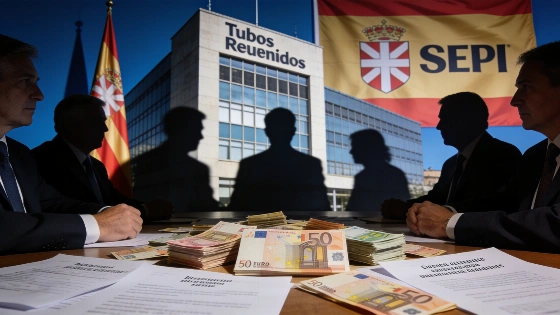
A corruption network allegedly involving top PSOE and PNV officials is under investigation. The case centers on a €112.8 million loan to Tubos Reunidos and €247,459 in commissions. Political pressure and secret communications are at the heart of the probe.
Spanish authorities are investigating a complex corruption scheme that allegedly connects senior figures from both the PSOE and PNV to irregularities surrounding a €112.8 million state-backed loan granted to the Basque company Tubos Reunidos. According to a detailed report by the Guardia Civil’s Unidad Central Operativa (UCO), the network’s reach extends to the highest levels of both parties, implicating former PNV president Andoni Ortuzar, vicelehendakari and PSE-EE Vizcaya secretary general Mikel Torres, and PSE-EE leader Eneko Andueza.
The UCO report reveals that the group, led by former PSOE Organization Secretary Santos Cerdán, played a decisive role in securing the 2021 loan from the Sociedad Estatal de Participaciones Industriales (SEPI) for Tubos Reunidos. The investigation highlights how Vicente Fernández, ex-vice president of SEPI, along with Leire Díez and Antxon Alonso, received €247,459 in monthly payments from Tubos Reunidos for their behind-the-scenes political lobbying. Payments were made through a shell company, Mediaciones Martínez, and directly to Fernández, with sums reaching up to €5,000 per month.
Ortuzar reportedly met with Fernández and Tubos Reunidos executives in January 2025 to negotiate favorable terms for the company, including a reduction in interest payments and exemption from returning €10 million to SEPI following the sale of a property in Sestao. The UCO notes that initial resistance from SEPI to grant the loan shifted after Fernández enlisted Alonso to encourage PNV leadership to intervene, as evidenced by intercepted communications.
Leire Díez, described as a key operative, intensified efforts in 2024 as Tubos Reunidos faced insolvency. She orchestrated a campaign of political pressure, targeting top Basque political figures. Notably, Díez exchanged 1,288 messages with Mikel Torres between October 2020 and May 2025, pressing for meetings and support for Tubos Reunidos. Torres, who became vicelehendakari in 2024, has denied meeting Díez regarding any company bailout, attributing their communication to local matters in Portugalete, where Díez was an active resident and Torres served as mayor until June 2024.
The investigation also points to Díez’s involvement in facilitating contacts between Tubos Reunidos and Eneko Andueza, though the outcome of these interactions remains unclear. The UCO’s nearly 200-page interim report suggests that the network’s activities intensified as the company’s financial situation worsened, with ongoing inquiries likely to expand the scope of the case.
While the Tubos Reunidos affair has drawn national attention, it echoes broader concerns about political influence and transparency in Spain. Recent cultural debates, such as those highlighted in the return of Jacinto Benavente’s classic play in Madrid, have also brought issues of power and social pressure to the forefront, as discussed in this feature on contemporary Spanish society.
For context, SEPI’s Fondo de Apoyo a la Solvencia de Empresas Estratégicas (FASEE) was established to support companies deemed vital to Spain’s economy during periods of crisis. The fund has previously been scrutinized for its role in high-profile bailouts, including the case of Plus Ultra. The current investigation into Tubos Reunidos underscores ongoing challenges in ensuring accountability and oversight in the allocation of public funds.