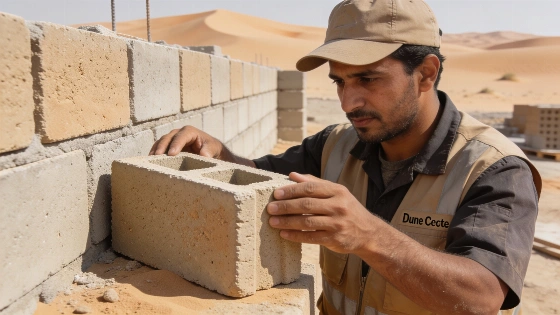
A Dubai-based company has developed DuneCrete, a new building material that uses desert sand once considered unsuitable for construction. The innovation promises up to 50% less cement and carbon, offering a sustainable alternative for architectural projects in harsh climates.
In Dubai, ARDH Collective has achieved what many in construction thought impossible: turning the region’s abundant desert sand into a high-strength building material. Their product, DuneCrete, is now being used to manufacture blocks, panels, and architectural elements with up to 50% less cement and a similar reduction in embedded carbon, according to the company’s technical data.
The challenge was clear from the start. Desert sand, shaped by centuries of wind, is too smooth and rounded to bind effectively in traditional concrete mixes. This has forced countries like the United Arab Emirates to import river sand for major projects, despite being surrounded by dunes. Architects Máximo Tettamanzi and Alyina Ahmed began tackling this problem during their studies in London, later continuing their experiments in a makeshift Dubai garage during the pandemic. After extensive testing, they stabilized a formula that could withstand rigorous compression tests, achieving a C39 strength rating.
Engineering a New Material
DuneCrete’s breakthrough lies in its ability to maintain structural strength while dramatically reducing cement content. The company claims up to 50% less cement and carbon, though the exact mix varies by product and application. The public documentation does not specify the precise ratios for each use, so the reduction is not guaranteed across all scenarios. Still, the material’s performance has been sufficient for architectural blocks, pavers, and customizable façade panels, as demonstrated at Dubai Design Week 2025.
Currently, DuneCrete is primarily used for decorative and architectural components rather than major load-bearing structures. Tettamanzi notes that broader adoption will require further testing and collaboration with engineering consultancies. The company has not yet published universal validation for all structural applications, but the early results have drawn attention from architects and sustainability advocates.
Design and Functionality
One of DuneCrete’s most striking uses is in DuneBlocks—modular, perforated blocks that filter sunlight and preserve privacy. These elements, showcased in the installation The Space Within, echo the traditional mashrabiya screens common in hot climates. The blocks allow interior spaces to remain bright and ventilated while shielding occupants from direct sun and outside view. While ARDH Collective highlights potential energy savings and improved airflow, comparative data on cooling or energy use has not yet been released. The company is also exploring 3D-printed variants, connecting DuneCrete to a wider movement of locally sourced, low-waste construction materials.
Expanding Local Resources
ARDH Collective’s focus on local materials extends beyond sand. Co-founder Alhaan Ahmed has developed DateForm, a solid surface material made from discarded date pits, which are roasted, ground, and combined with resins. This innovation is being used for furniture and interior finishes, further reducing reliance on imported resources. Both DuneCrete and DateForm reflect a strategy of turning regional byproducts into valuable construction materials, though their technical properties and applications differ from other eco-brick solutions on the market.
Context and Outlook
The push for sustainable construction materials is gaining momentum worldwide, as the sector faces mounting pressure to cut emissions and reduce resource consumption. DuneCrete’s approach—using what was once considered waste—offers a glimpse of how local innovation can reshape building practices in extreme environments. As the company works toward broader certification and industrial scaling, its progress will be watched closely by architects and developers seeking greener alternatives. For comparison, Spain is also grappling with infrastructure challenges, as highlighted in a recent analysis of urgent road repairs and funding gaps amid rising construction demands.
For now, DuneCrete stands as a promising example of how rethinking local resources can drive both environmental and practical benefits in the construction industry.