Gridlock with no crash, no debris, and no warning sign—Spain’s highways keep seizing up. The real trigger is drivers slowing to look, turning minor distractions into sprawling jams and new hazards.
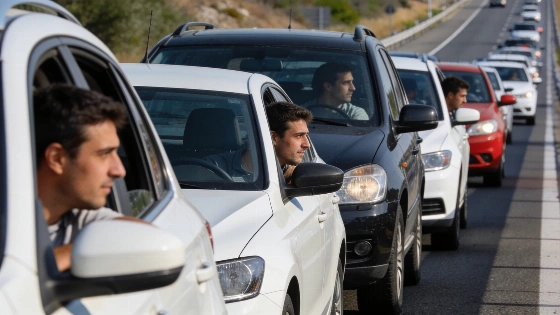
Engines idle and horns sound as traffic locks up on a Spanish motorway. No crash blocks the lanes. No breakdown flashes its warning lights. The only clue: a handful of drivers easing off the gas to gawk at something on the shoulder, setting off a chain reaction that brings hundreds of vehicles to a crawl.
Locals call it the ‘efecto mirón’—the compulsion to stare at roadside incidents, even when they’re far from your lane. Spain’s highways see this play out daily. The Real Automóvil Club de España (RACE) has flagged this reflex as a stubborn threat to road safety. Curiosity takes the wheel, and the result is a rolling wave of brake lights and frayed nerves.
According to Spain’s DGT, distraction was present in 18% of all traffic accidents in 2024 and was a contributing factor in 30% of fatal crashes—406 cases in total.
Psychologists call this ‘attentional capture.’ A police cruiser, a flicker of hazard lights, or a dented bumper on the verge grabs the brain’s focus. Eyes drift, attention slips, and for a few seconds, the road ahead fades from view. Phones and dashboard screens aren’t the only culprits. Even a fleeting glance is enough to set off trouble. The real kicker: this lapse spreads fast. One driver taps the brakes, the next follows suit, and soon a clear lane turns into a bottleneck. The jam grows, stretching for kilometers, with no visible cause left behind.
Physics does the rest. A single slowdown ripples backward, each car braking harder than the last. This ‘accordion effect’ lingers long after the original distraction disappears. When curiosity triggers the first tap, the jam can appear and vanish without warning.
The fallout isn’t just lost time. Every needless brake raises the odds of a rear-end crash, especially when drivers tailgate. The mess often spills into the opposite lanes as onlookers slow down to snap photos or stare, doubling the gridlock. Fuel burns, emissions spike, and emergency crews face fresh hurdles reaching real emergencies—sometimes forced to handle new accidents sparked by distracted drivers.
The DGT defines distraction as any shift of attention away from tasks necessary for safe driving, including not only mobile phone use but also eating, adjusting vehicle systems, or interacting with passengers. While distraction from looking at roadside incidents is not tracked as a separate category, it is recognized as a form of visual and cognitive distraction that can trigger chain-reaction braking and phantom jams.
Psychology of the jam
Traffic pressure builds fast. Dwight Hennessy, psychology professor at the State University of Buffalo, told the American Psychological Association’s podcast Speaking of Psychology that the daily drive piles up small stressors. The push to get somewhere quickly can tip drivers into risky moves, especially when a jam forms out of nowhere thanks to collective rubbernecking.
Stuck in a phantom jam, drivers often swerve between lanes or slam the horn. Research by Eric A. Morris and Jana A. Hirsch in Travel Behaviour and Society points out that while traffic is maddening, it rarely causes lasting mental health damage. Still, the urge to blame the road for a bad mood is strong—especially when the cause is so hard to spot.
Breaking the cycle
No gadget or app can override human curiosity. The only fix is discipline: eyes ahead, hands steady, and focus on the road. If emergency crews are already working, drivers are expected to keep moving, hold a safe gap, and follow directions. Stopping to film or gawk isn’t just pointless—it’s often illegal and always risky. If you’re first to arrive, the PAS protocol—Protect, Alert, Aid—applies, but only with calm and care.
Spain’s car culture runs deep. The country’s first registered vehicle, as reported earlier, kicked off a national obsession with driving. As the roads filled up, so did the chances for distraction and delay.
The ‘efecto mirón’ puts civic responsibility to the test. Every driver who keeps their eyes forward helps traffic flow and cuts risk for others. On Spanish highways, where jams can materialize out of nowhere, the most effective tool is still the discipline to look ahead and keep moving.