Room 74 now displays 17 sculptures from Cristina de Suecia's collection, up from nine. The Prado has also made the Room of the Muses a permanent focus for the queen's collecting life in Rome.
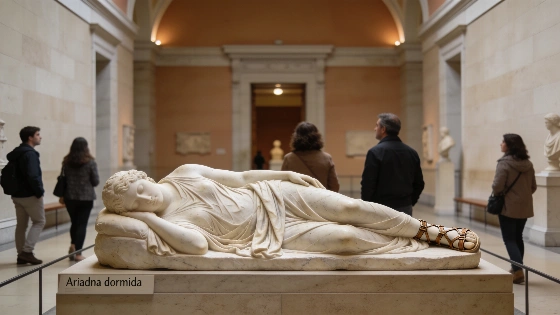
Room 74 now holds 17 sculptures, up from nine. The Museo del Prado made the change as part of its programme marking four centuries since Cristina de Suecia's birth. Ariadna dormida sits at the centre. The work was once identified as Cleopatra and now carries a link to the queen's own life as a sovereign far from her homeland.
The collection entered the Spanish royal holdings after Cristina's death. Livio Odescalchi acquired part of it in Rome in 1692. His heir sold that group to the Spanish crown in 1724. The sculptures later stood at places including the palace of La Granja. In 1829, they moved to the Royal Museum of Painting and Sculpture, the predecessor of the modern Prado.
After Cristina’s death, Livio Odescalchi acquired part of her collection in Rome in 1692. In 1724, his heir sold it to the Spanish crown, beginning its institutional history in Spain.
Ariadna dormida now lies horizontally at the centre of the room. Visitors can see the folds of the drapery and the details of the sandal straps from different angles. The museum has also changed the lighting and pedestals. Desirée González created the new pedestal design.
The Prado says the room is arranged for a circular view. That layout lets visitors see links between the sculptures as well as details in each work.
The old name, Cleopatra, connected the sculpture with another queen seen by the museum as displaced from her homeland. The seventeenth-century identification was later revised to Ariadna dormida. The comparison between the two exiled queens belongs to the museum's interpretation. It is not the sculpture's current attribution.
That choice gives the room a clear centre.
The selection includes Hellenistic works and Roman copies of Greek originals. It also contains imperial busts carved from marbles in different colours. Visitors can see Venus with a Dolphin, Venus with a Tortoise, busts of Antinous and Achilles, and two heads of Athena.
Two Athena or Minerva busts recall Cristina's reputation at European courts as the "Minerva del norte". The display also includes sculptures of Aphrodite and the bronze Cabeza colosal de príncipe, which was long regarded as Alexander the Great.
The Room of the Muses presents eight sculptures that Cristina bought in 1670 for her Roman palace. They are shown alongside an equestrian portrait of the queen by Sebastián Bourdon, extending the display from sculpture to the culture of her court.
Fauno del cabrito is another major attraction. Across Europe, it is known as the Fauno de la reina Cristina.
Manuel Arias, head of the Prado's Collection of Sculpture up to 1700, said the work was copied thousands of times. Academies across Europe studied it. He also said Spain acquired Cristina's collection because the country lacked an important group of classical sculpture at the time. The purchase strengthened the Spanish royal art holdings.
Cristina's works appear beyond room 74. They are spread across rooms 71, 72, 73, 74, 47 and 55B. The museum has also created a permanent focus on the Swedish queen's intellectual life and collecting interests.
In the Room of the Muses, visitors can see a treatise by Leonardo da Vinci dedicated to Cristina. The eight sculptures intended for her Roman palace are shown there as well.
The same room will temporarily hold a new installation of Talía. One of the pedestals commissioned by Cristina will accompany it. The pedestal is made of marble and wood. It shows that her project covered the setting around the sculptures, not just the works themselves.
A smaller connected room contains four colossal sculptures. Cristina once owned two of them, Apolo and Júpiter Tonante. Venus del pomo occupies the central position. The group takes the display from intimate busts to monumental figures linked to the queen's Roman residence.
EFE reports that the renewed rooms will launch a programme organised by the Prado and the Embassy of Sweden in Spain during the last quarter of 2026. The activities will examine different parts of Cristina's life. They will coincide with the four-hundredth anniversary of her birth.
The museum is treating room 74 and the Room of the Muses as a lasting space devoted to the queen and her collecting activity.
The curatorial choice gives the collection a clear historical shape. Cristina's taste for sculpture is placed alongside Rome, the Spanish monarchy and the movement of artistic knowledge. The Prado's official account describes the collection as one of the foundations of its classical sculpture holdings. The new display shows how a queen's private collection became part of Spain's public museum heritage.