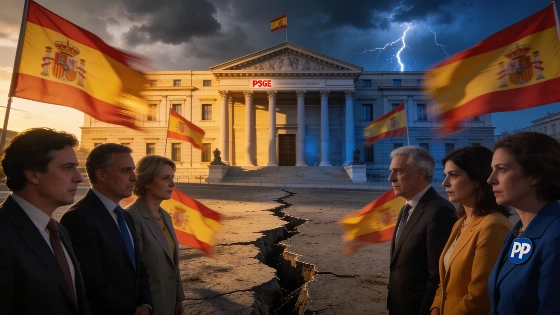
Spain's main parties are locked in a tense pre-election phase. Judicial cases and internal crises test PSOE, while PP eyes power but faces doubts. The outcome could reshape alliances and impact national policies.
Spain's political climate has entered a new phase of tension as both the PSOE and the PP intensify preparations for the next general elections, expected in 2027. Despite a year marked by judicial investigations and internal scandals, the PSOE leadership insists the government will complete its term, while the PP, led by Alberto Núñez Feijóo, positions itself as the likely successor.
Over the past year, the PSOE has faced a series of high-profile legal challenges, including corruption convictions for José Luis Ábalos and David Sánchez, as well as ongoing scrutiny involving Begoña Gómez. These cases have fueled speculation about the government's stability. However, senior PSOE officials now express renewed confidence, citing improved polling and a belief that the party can still mobilize progressive voters, especially in regions like Catalonia and the Basque Country. The leadership views the judicial pressure as a potential rallying point, arguing that attacks from the opposition may backfire and energize their base.
Within the PSOE, there is recognition that the party has endured significant setbacks, particularly in recent municipal and regional elections in areas such as Extremadura and Andalusia. Some local leaders warn that further losses in upcoming local contests could weaken the party's national standing. The government, meanwhile, has managed to pass several legislative initiatives but continues to struggle with budget approvals, using the current impasse as a platform for its electoral agenda.
On the opposition side, Alberto Núñez Feijóo has increased his public presence and sharpened his rhetoric, signaling a readiness to govern in coalition with Vox and, if necessary, with support from parties like Junts. Feijóo's strategy now openly embraces the possibility of a right-wing bloc, moving away from earlier calls for a solo PP government. The PP leadership is confident, citing favorable polling and recent electoral gains, but internal voices caution against complacency, noting that the PSOE remains resilient despite ongoing legal troubles.
Vox, for its part, has tempered expectations, warning the PP not to underestimate the PSOE's ability to recover, referencing the unexpected outcomes of the 2023 elections. The evolving relationship between the PP and Vox has led to new coalition agreements at the regional level, with the PP seeking to contain Vox's influence while benefiting from their support. The adoption of policies inspired by the far right, such as the concept of 'national priority,' has become more visible, particularly in regional budgets.
Feijóo's efforts to strengthen his profile in the European context continue, with planned appearances alongside international figures aligned with Vox. The PP's approach to alliances and its stance on institutional reforms are likely to remain central issues as the election approaches.
Spain's political landscape is thus defined by uncertainty and shifting alliances. The outcome of the next general elections will have significant implications for the country's direction, particularly regarding coalition dynamics, judicial reforms, and the balance of power between national and regional interests. As both major parties recalibrate their strategies, the coming months are expected to bring further developments that could alter the trajectory of Spanish politics.
For context, Spain's political system has seen increasing fragmentation in recent years, with coalition governments becoming the norm. The rise of new parties and the influence of regional blocs have complicated traditional two-party dynamics. Judicial investigations into political figures have played a prominent role in shaping public debate and party fortunes. The next election cycle is expected to test the resilience of established parties and the effectiveness of new alliances, with potential consequences for economic policy, regional autonomy, and Spain's role within the European Union.