The European Solar Telescope now has ESFRI Landmark status. Spain leads the La Palma project, which will use a 4.2-metre mirror to study solar magnetic activity and space weather.
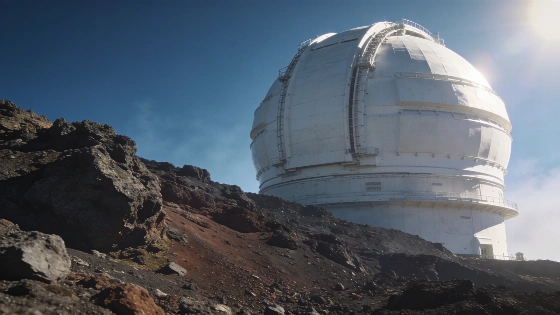
ESFRI approved the European Solar Telescope at its 97th meeting in Cork on 23 and 24 September 2026. The decision puts the project among Europe's strategic research infrastructures. Spain plans to build the telescope at the Observatorio del Roque de los Muchachos on La Palma. Europa Press reported the decision, citing the Instituto de Astrofísica de Andalucía (IAA-CSIC).
Landmark is not a ceremonial label. ESFRI uses the category for research infrastructures that are already operating or have reached an advanced stage of execution and are considered strategic for Europe. The list also includes the Observatorio CTA (CTAO) and the Observatorio del SKA (SKAO). The Instituto de Astrofísica de Andalucía (IAA-CSIC) participates in both.
Current planning reported by regional Spanish media points to construction beginning around 2028 and the telescope entering service around 2038. These dates are operational targets rather than a final approved timetable.
The telescope will study the Sun in very fine detail. Its measurements will add to data from space missions and help researchers examine space weather. The work will focus on how solar activity affects Earth's space environment.
That requires several countries to stay involved. Manuel Collados, the project coordinator, says one institution or one country could not build infrastructure of this scale alone. The next task is to turn the shared scientific plan into long-term commitments for construction.
The project has been on the ESFRI Roadmap since 2016. Spain leads it through the Instituto de Astrofísica de Canarias and the CSIC via the IAA-CSIC. Since 2023, both institutions have belonged to the Fundación EST with eight other entities from seven European countries.
The partnership is already in place.
The ESFRI meeting in Cork was also linked to preparations for the ESFRI Roadmap 2026, which stakeholders expected to present on 2 December 2026 in Rome. The EST decision is therefore part of a broader European process for coordinating strategic research infrastructures.
The planned instrument will have a 4.2-metre primary mirror. Its instruments will observe several heights of the solar atmosphere at different wavelengths at the same time. Researchers want to track the emergence of magnetic fields on the Sun's surface. They will also study how energy moves into the upper atmosphere and what physical processes are linked to solar eruptions.
The project's European scale differs sharply from the household focus of the earlier Euribor report. One story concerns borrowing costs. The other concerns a research facility that depends on commitments from several countries. Both involve decisions whose effects last beyond the day they are announced.
The telescope could also help with research on other stars and the habitability of exoplanets. For Spain, La Palma would host a facility with national and European scientific value. ESFRI recognition gives the project stronger institutional backing. Construction still depends on the long-term commitments that Manuel Collados described.