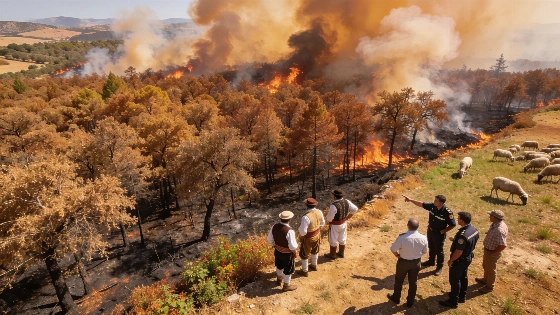
Andalusian farmers and ranchers call for urgent reforms to allow preventive work in forests. They warn that abandoned land management is fueling wildfire risk. Tensions rise as political parties debate responsibility.
Andalusian agricultural organizations are pressing for immediate changes to forest management rules, arguing that the decline of traditional farming and livestock practices is leaving the region dangerously exposed to wildfires. After the recent devastating fire in Almería, rural groups have urged authorities to let farmers and ranchers carry out preventive work in public forests without waiting for official permits. They warn that years of neglect and restrictive policies have led to a dangerous buildup of dry vegetation, increasing the risk of catastrophic fires.
Antonio Campos, a veteran shepherd from Peal de Becerro (Jaén), describes a sector in crisis. He notes that the number of livestock in his area has plummeted over the past decade, with little hope for generational renewal. Campos, who manages 750 Segureña sheep in the Sierra de Cazorla, says none of his four children plan to continue his work. This decline, he argues, undermines the rural workforce that once helped keep forests clear of combustible material.
Jesús Cózar, secretary general of UPA Andalucía, emphasizes that farmers and ranchers are essential for maintaining the rural landscape and biodiversity. He calls for the revival of local emergency plans, self-protection strategies, and awareness campaigns focused on fire prevention. Cózar also highlights the importance of controlled burning of agricultural and forest residues, a practice that has been restricted in recent years.
UPA Andalucía points to the Los Gallardos fire in Almería as evidence of the urgent need for closer cooperation between authorities and the agricultural sector. According to Cózar, effective fire prevention requires year-round active land management, not just emergency response when a blaze breaks out. The presence of farmers and livestock, he says, helps reduce biomass, maintain a patchwork landscape that slows fire spread, and keep rural areas inhabited and productive.
Asaja, another major agricultural group, has submitted an urgent request to both the Junta de Andalucía and the national government. They seek legislative reforms to allow preventive work without prior authorization and demand adequate resources for these tasks. Luis Carlos Valero of Asaja Jaén stresses that the abandonment of traditional land use and the lack of active forest management have created vast stretches of unbroken, fuel-rich terrain—ideal conditions for wildfires to spread unchecked.
The problem is especially acute in protected forest areas. Jaén province, for example, has around 645,000 hectares of forest, nearly half its territory, with more than 300,000 hectares under some form of environmental protection. This makes Jaén the Spanish province with the highest percentage of protected forest land, at 72%. Asaja warns that unless authorities remove bureaucratic barriers and improve forest management, they will hold officials accountable in court for any resulting disasters.
The debate over forest management has also entered the political arena. Asaja's proposals align with the positions of Vox, which has made forest policy a key part of its agreement with the PP to join the Andalusian government. Vice President Manuel Gavira insists that political leaders must prioritize forest cleaning and management, especially after heavy rains that spur rapid grass growth. He points to a recent government pact that promises to allocate more funds for fire prevention and to review regulations that limit the role of rural workers in forest upkeep. Gavira, however, downplays climate change as the main cause of wildfires, arguing that political responsibility and practical measures are more important than ideological debates.
The PSOE, meanwhile, has sharply criticized the Junta de Andalucía for what it calls inadequate maintenance and funding of rural roads, a problem worsened by recent storms. Juan Latorre, PSOE leader in Jaén and mayor of Arjona, says local mayors are increasingly concerned about the deteriorating state of rural infrastructure, which complicates both prevention and emergency response efforts.
This renewed focus on rural land management comes as Andalusia faces mounting wildfire risks. The recent tragedy in Los Gallardos, where 13 people died and thousands of hectares burned, has intensified calls for reform. For more on the political fallout and official responses to the Almería fire, see this detailed report: Andalusian vice president addresses Parliament after deadly Los Gallardos wildfire.
Spain's wildfire risk is closely linked to rural depopulation and the decline of traditional land uses. As fewer people work the land, forests become denser and more flammable. Controlled grazing, prescribed burns, and mosaic landscapes have historically helped limit fire spread. In recent years, however, regulatory hurdles and demographic shifts have made these practices less common. The debate in Andalusia reflects a broader national challenge: balancing environmental protection with practical land management to reduce the threat of catastrophic wildfires.