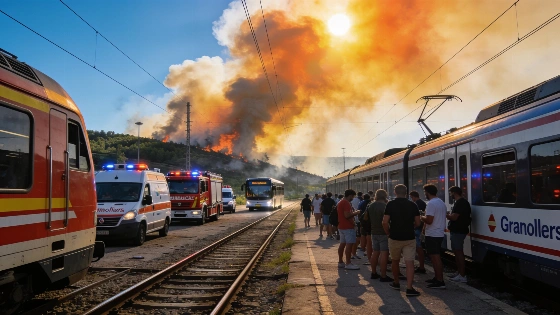
Train traffic on the Rodalies R3 line was halted after a vegetation fire near Granollers. Replacement buses were deployed for affected passengers. The incident adds to a series of disruptions on Catalonia’s rail network.
Rail service on the Rodalies R3 line was brought to a standstill on Wednesday morning after a vegetation fire broke out between Granollers and Canovelles, directly impacting the tracks. The disruption, which coincided with the Sant Joan holiday, forced the suspension of all train traffic between L’Hospitalet de Llobregat and Puigcerdà, affecting key commuter routes through Granollers and Vic. Rodalies responded by arranging bus transfers for stranded passengers, but the interruption quickly became the most severe among several incidents affecting Catalonia’s railways that day.
The R3 line has faced repeated setbacks in recent months. Just a day earlier, service between Ripoll and Ribes del Freser was halted for several hours due to cable theft. Ongoing construction delays have further complicated the situation. The section between L’Hospitalet and Mollet del Vallès, originally scheduled to reopen in May, remains closed after a cement factory wall collapsed onto the tracks in March. The resulting dispute between Adif and the factory over responsibility for the damage has stalled progress, with Adif now set to rebuild the wall. The full reopening of the line has been pushed back to January 2027, aligning with the completion of the double-tracking project between Parets and la Garriga.
Other Rodalies lines also experienced problems on Wednesday. The R4 line resumed operations around 11:10 a.m. after a car fell onto the tracks between Sabadell Sud and Barberà del Vallès, causing a temporary halt. Meanwhile, both the R2 and R4 lines were suspended between Barcelona and Montcada i Reixac due to infrastructure issues, compounding the difficulties for commuters during one of the busiest travel periods in Catalonia.
Rail disruptions have become a recurring challenge for Catalonia’s transport network, particularly during peak travel times and public holidays. According to official data, the Rodalies network serves hundreds of thousands of passengers daily, making any prolonged suspension a significant inconvenience. Infrastructure upgrades and maintenance projects are ongoing, but incidents like fires, theft, and accidents continue to expose vulnerabilities in the system. The repeated delays and disputes over responsibility highlight the complexity of maintaining and modernizing critical rail links in the region.