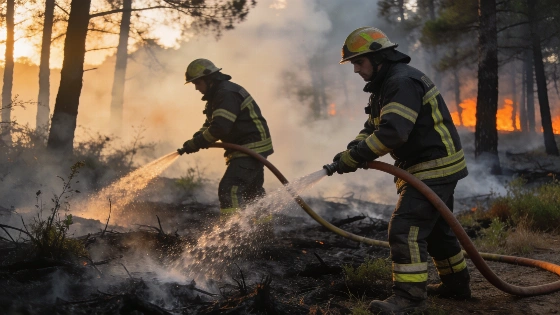
The wildfire near Niebla remains difficult to control. Authorities report improved conditions overnight, but shifting winds and dry air threaten progress. No towns are currently at risk, but the situation is still tense.
Efforts to contain the wildfire near Niebla, in the province of Huelva, entered a critical phase on Sunday as emergency teams reported some overnight improvement but warned that the situation remains complex. According to Francisco Toscano, acting Government Delegate in Andalucía, the fire continues to pose significant challenges, with no residential areas currently under threat but with unpredictable weather conditions complicating the response.
Speaking from the advanced command post, Toscano explained that cooler nighttime temperatures and calmer winds allowed crews to reinforce containment lines, particularly on the left and right flanks of the fire, as well as around the Villarrasa recycling plant and a local greenhouse. These gains, however, are threatened by forecasts of shifting winds and very low humidity during the day, which could accelerate the spread of flames and undermine the progress made overnight.
Air support resumed at first light, focusing on the head of the fire to support ground teams from the Unidad Militar de Emergencias (UME) and Plan Infoca. Their main objective is to strengthen defensive lines and prevent the fire from advancing toward the Río Tinto area. Toscano noted that while the eastern flank is being closely monitored, the most affected zones remain forested, with no immediate risk to populated areas.
Authorities remain cautious, as wind patterns have been unstable since Thursday, frequently changing direction and reaching speeds of up to 35 kilometers per hour. This unpredictability, combined with the region's highly combustible vegetation and difficult terrain, continues to hinder firefighting operations. Toscano emphasized that the top priority is the protection of human life, referencing the evacuation of 340 residents the previous afternoon as a precautionary measure.
On Sunday, Sara Aagesen, the Third Vice President and Minister for Ecological Transition and Demographic Challenge, joined the emergency committee at the command post to assess the evolving situation. Her presence underscores the national significance of the incident and the ongoing coordination between local, regional, and national authorities.
Wildfires have become an increasingly frequent challenge in Spain, particularly in Andalucía, where prolonged drought and high temperatures have heightened the risk in recent years. The Niebla fire is the latest in a series of incidents that have tested emergency response systems and highlighted the importance of rapid, coordinated action. The impact of such events extends beyond immediate danger, affecting local economies, agriculture, and long-term land management strategies. For comparison, the closure of La Camarga restaurant in Barcelona after a political scandal and the pandemic, as detailed in this recent report, illustrates how unexpected crises can leave lasting marks on communities and industries.
As the situation in Niebla develops, authorities urge residents to remain alert and follow official instructions. The coming hours will be decisive, with weather conditions likely to determine whether containment efforts hold or new evacuations become necessary. The experience gained from recent wildfires is shaping current strategies, but the unpredictable nature of the elements means that vigilance remains essential.