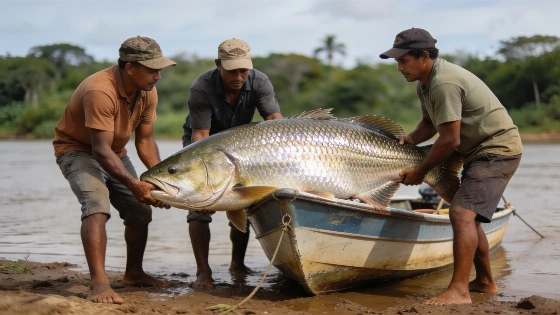
Roberto do Carmo Jesus spent 45 minutes fighting a 160-kilo pirarucú in the Marinheiro River, São Paulo. The catch, too large for his boat, comes as Brazil tightens rules on this invasive species outside the Amazon. The story highlights the growing impact of non-native fish in Brazilian waters.
Roberto do Carmo Jesus, 53, faced an extraordinary challenge on November 28, 2025, when he hooked a massive pirarucú in the Marinheiro River, a tributary of the Rio Grande in São Paulo state. The fish, weighing around 160 kilos and stretching 2.5 meters, was so large it could not fit in his boat. Alone on the water, Roberto was forced to tow the giant catch to shore, where three men helped him lift it onto a scale.
The battle began when the pirarucú struck the rod with the thinnest line. The initial pull was sudden and forceful, threatening to snap the tackle. Over the next 45 minutes, Roberto carefully wore down the fish, balancing patience and skill to avoid losing it. The catch shattered his previous personal record of 115 kilos and provided over 100 kilos of fillets, which he later sold for more than 4,000 reais.
Changing Rules for an Invasive Species
This dramatic catch took on new significance in March 2026, when Brazil's environmental agency Ibama classified the pirarucú as an invasive species outside its native Amazon basin. The new regulation, Instrução Normativa 07/2026, authorizes fishing of pirarucú in ten hydrographic regions, including the Paraná basin, as a population control measure. Authorities warn that the species, a top-level predator, can threaten local fauna where it is not native.
Under the new rules, fishing pirarucú outside the Amazon is not just permitted but encouraged, provided it follows local environmental guidelines. The regulation aims to limit the ecological impact of this powerful fish, which has proven adaptable and opportunistic in new habitats.
Unique Biology and Adaptation
The pirarucú stands out not only for its size but also for its biology. As it matures, its swim bladder transforms into a lung-like organ, making it an obligate air-breather. This adaptation allows the fish to survive in oxygen-poor waters, but it still depends on aquatic environments for movement and survival. While it can endure brief periods out of water if kept moist, it cannot live on land.
Roberto's experience is not unique. Other anglers have reported encounters with giant freshwater fish, such as the great white shark known as Contender, which recently resurfaced in the Atlantic and drew attention for its size and migration patterns (see more on the Atlantic shark's journey).
Economic and Environmental Impact
With over 30 years of fishing experience and more than a hundred pirarucús caught, Roberto has witnessed firsthand how the species has spread beyond its original range. The economic benefit from such a catch is significant, but the environmental risks are now at the center of national policy. The Ibama directive reflects growing concern over invasive species and their effect on Brazil's diverse aquatic ecosystems.
As the country adapts to new regulations, cases like Roberto's highlight the complex balance between economic opportunity and ecological responsibility. The story of the 2.5-meter pirarucú is a vivid example of how a single catch can symbolize broader changes in environmental management and local livelihoods.