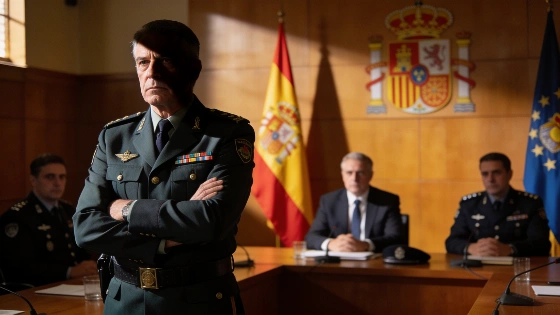
Luis del Castillo, head of Guardia Civil operations, faces allegations of pressuring officers to disrupt official acts in Madrid. His career is marked by political ties and internal disputes. The controversy exposes deep divisions within the force.
Senior Guardia Civil officer Luis del Castillo is at the center of a growing controversy after being accused of pressuring subordinates to undermine official events led by Madrid regional president Isabel Díaz Ayuso. According to details published by ABC, Del Castillo, who currently serves as chief of operations and is considered the right hand of the director adjunto operativo (DAO), allegedly demanded that Fernando Mora, the Madrid zone chief, participate in a politically motivated boycott of the Dos de Mayo celebrations. When Mora refused, Del Castillo reportedly responded with threats and aggressive language, escalating internal tensions within the force.
Colleagues describe Del Castillo as a divisive figure, often characterized by a lack of engagement with peers and a reputation for following political directives rather than standing out for professional merit. Despite holding significant authority, he is seen by many within the Guardia Civil as an average performer who advanced through the ranks by aligning with influential political figures. Recordings cited by ABC suggest that Del Castillo threatened Mora with dismissal if he did not comply with instructions from Mercedes González, the current director of the Guardia Civil and former PSOE Madrid secretary general.
Del Castillo's approach to leadership has drawn criticism for blurring the lines between the institution's neutrality and political interests. Notably, his formal treatment of González—always addressing her with the utmost respect—has been interpreted by colleagues as a sign of his willingness to accept political guidance, a practice considered unusual in the traditionally independent Guardia Civil. His nickname, 'el Puñales', reflects a perception among some that he prioritizes self-preservation over loyalty to colleagues, as seen in his distancing from Diego Pérez de los Cobos, a colonel dismissed in a case later ruled illegal by the Supreme Court.
Born in Bilbao in 1963 and raised in Cantabria, Del Castillo's career has spanned multiple regions and specialized units, including the Grupo de Acción Rápida (GAR) in Logroño, the Grupo Rural de Seguridad, and the Barcelona Traffic Subsector. He later held posts in training centers in Guadarrama and Logroño, before returning to Bilbao as a commander and then as a lieutenant colonel, focusing on personnel and logistics. His subsequent promotions took him to Santander as a colonel and to León as a brigadier general, before reaching his current position. Throughout his ascent, Del Castillo developed close ties with Virginia Barcones, former government delegate in Castilla y León and now secretary general for Civil Protection and Emergencies, who played a key role in his advancement. Even Del Castillo himself reportedly acknowledged in a WhatsApp group that his promotion was unexpected, a sentiment echoed by peers who doubted he would have reached such a high rank under normal circumstances.
The case has highlighted ongoing debates about the influence of politics within Spain's security forces. Similar concerns have surfaced in other high-profile cases, such as the legal dispute involving a former National Police official, which also raised questions about internal accountability and the handling of sensitive allegations. For further context on recent controversies within Spanish law enforcement, see the report on a former police executive seeking dismissal of a sexual assault case.
Spain's Guardia Civil, established in the 19th century, is tasked with a wide range of responsibilities, from rural policing to counterterrorism. The force has long prided itself on its independence from political influence, but recent incidents have brought renewed scrutiny to its internal culture and promotion practices. The current dispute involving Del Castillo underscores the challenges faced by the institution as it navigates the balance between operational integrity and external pressures. As the situation develops, the outcome may have lasting implications for leadership standards and the perception of neutrality within Spain's security services.