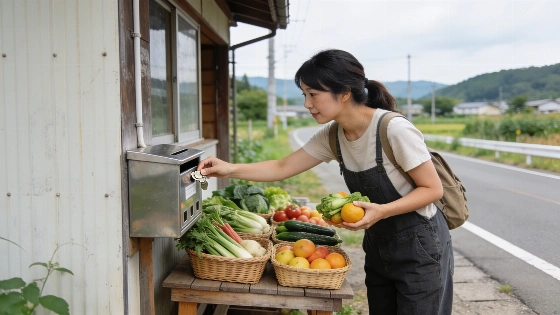
Across Japan, small unmanned farm stalls known as mujin hanbai offer fresh fruit and vegetables with no staff, relying on visible prices and honesty boxes. As thefts rise, some stalls now use lockers and vending machines, blending tradition with modern solutions.
On the outskirts of Tokyo and in rural villages alike, a quiet experiment in trust continues: unmanned farm stalls, or mujin hanbai, where customers select produce, pay into a simple box, and leave—often without ever seeing the farmer. These stalls, a familiar sight in Japan, operate without staff, cash registers, or surveillance, relying instead on visible prices and the honesty of each visitor.
The basic setup is straightforward. Farmers place freshly harvested fruit and vegetables in bags or baskets, each marked with a price. Customers take what they need and drop the exact amount into a wooden or metal box. There is no change, no receipts, and usually no one watching. The system depends on mutual respect and the understanding that the produce is meant for everyone in the community.
How the System Works
While many mujin hanbai stalls are found near farms, the model has spread to urban areas. In Setagaya, a district of Tokyo, the local government recently mapped over 100 direct-sale points, some equipped with vending machines for vegetables. The stalls allow farmers to sell small batches, odd-sized produce, or items not suitable for large-scale distribution, providing extra income without leaving the fields for hours. For buyers, the appeal is clear: access to local, seasonal food at fair prices, often just steps from home.
Despite the rise of mobile payments in Japanese retail, most mujin hanbai still operate with coins and round prices. The simplicity is part of the charm—and the challenge.
Trust and Its Limits
The mujin hanbai system is often held up as a symbol of Japanese social honesty, but the reality is more nuanced. According to a 2015 report by Japan Up Close, farmers typically recover 80–90% of expected sales, meaning some money—and produce—does go missing. Some stalls have responded by installing coin-operated lockers, which secure the goods but remove the tactile experience of choosing produce by hand.
Recent data from the Kanto Regional Office highlights the risks. One farm in Kokubunji reported annual losses exceeding 100,000 yen due to theft and underpayment. In some cases, persistent losses have forced farmers to abandon the unmanned model altogether. While outright theft is not the norm, the system’s success depends on a high, but not perfect, level of community trust.
Modern Solutions for Old Problems
To address these challenges, technology is making inroads. In late 2023, NTT AgriTechnology introduced an automated vending service for farm products, featuring 21 compartments with prices set between 100 and 600 yen. Customers insert coins, unlock a compartment, and take their chosen bag. Some models require no electricity and offer ventilation or refrigeration, adapting to different foods and locations.
Farmers like those at Shimazaki, who installed the first unit, report that thefts stopped after switching to the new system. Meanwhile, digital tools such as the MieVege app, launched in Tokyo in 2022, let customers check real-time stock before visiting, while farmers can monitor sales remotely and restock as needed. These innovations preserve the self-service spirit while adding layers of control absent from the traditional model.
Why Mujin Hanbai Endure
Japan’s aging agricultural workforce—over 70% are older than 65—makes labor-saving solutions attractive. With fewer hands available, unmanned stalls offer a practical way to sell produce without hiring staff. The model is not limited to remote villages; urban districts like Setagaya now feature a mix of private stalls, cooperative sales points, and coin-operated machines, though not all are strictly mujin hanbai.
Compared to high-tech stores staffed by robots, these stalls represent a minimalist form of automation. Their continued presence reflects a blend of proximity, low cost, small-scale sales, and evolving community trust, now supported by discreet technological upgrades.
As Japan’s rural landscape changes, mujin hanbai remain a testament to both tradition and adaptation—quietly proving that, with the right balance of trust and innovation, even the simplest systems can endure.