Aichi researchers have developed a soy-based feed that shifts the sex ratio of farmed Japanese eels, producing larger, more valuable females. The discovery could reshape aquaculture practices and boost yields, but its effects are species-specific.
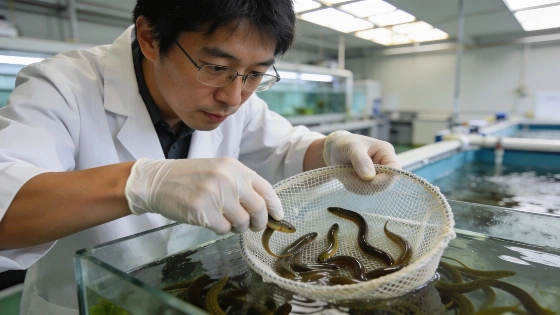
At the Aichi Fisheries Research Center in Japan, scientists have managed to overturn the natural sex ratio of farmed Japanese eels by introducing soy isoflavones into their juvenile feed. The result: more than 96% of treated eels developed as females, a dramatic reversal from the usual male-dominated outcome in aquaculture environments.
The research team targeted the early growth phase, when eel gonads have not yet differentiated. By adding varying concentrations of soy isoflavones to commercial feed, they found that the highest dose—50 grams per kilogram—produced a 96.6% female population. In contrast, the control group, which received no isoflavones, yielded 92.6% males. This shift is significant for the industry, as female eels grow larger and command higher market prices due to their softer flesh and greater commercial value.
How Soy Isoflavones Influence Sex Development
The experiment began with eel fry averaging just 0.33 grams. Over a controlled period, the fish were fed diets containing 2, 10, or 50 grams of soy isoflavones per kilogram of feed. Only 9.3% of eels became female at the lowest dose, but the proportion soared to 91.6% at the intermediate level and 96.6% at the highest. The timing of the intervention was crucial, as it allowed researchers to steer sexual differentiation before the gonads matured into ovaries or testes.
Soy isoflavones are plant compounds that can mimic estrogenic effects in fish by binding to estrogen receptors. This approach is part of a broader trend in agri-food innovation, where plant-based ingredients are used to enhance production efficiency and sustainability.
Genistein Proves Most Effective
The team also compared two major soy isoflavones: genistein and daidzein. Genistein stood out, with just one gram per kilogram of feed resulting in over 80% females. Even at higher doses, this effect persisted. Daidzein, however, was far less effective; at five grams per kilogram, 66.7% of eels remained male and only 9% developed ovaries.
To understand the underlying mechanism, researchers analyzed gene expression in the gonads. Eels fed isoflavones showed increased activity in foxl2a and cyp19a1—genes linked to female development—while genes associated with testis formation, amh and gsdf, were suppressed. This pattern suggests genistein alters the molecular pathways that determine sex in eels, producing an effect similar to synthetic estrogen treatments but with a plant-based compound.
Why Female Eels Matter in Aquaculture
For Japanese eel farms, producing more females is a practical goal. Females not only grow larger but also yield higher profits. Controlling the sex ratio allows producers to maximize output and efficiency. However, the study's results are specific to Japanese eels and to the controlled conditions of the experiment. The authors caution that the same approach may not work for other species, and that the effects of phytoestrogens can vary depending on species, dosage, and timing.
The research focused on sexual differentiation and gene expression, not on the full economic impact or large-scale commercial trials. Questions remain about feed costs, long-term viability, and how the method would perform in industrial-scale operations.
Limits and Broader Context
The study was conducted exclusively on Japanese eels in aquaculture tanks, with fry distributed into separate groups and fed experimental diets six days a week. Sex was determined after at least 120 days, once the eels exceeded 30 centimeters, through histological examination of the gonads.
While genistein proved highly effective in feminizing eels, the researchers emphasize that responses to phytoestrogens are complex and species-dependent. The findings do not suggest that soy consumption would have similar effects in humans, as the experiment involved juvenile eels at a specific developmental stage and controlled feed concentrations.
The full study, titled Soy Isoflavones Induce Feminization of Japanese Eel Anguilla japonica, was published in the International Journal of Molecular Sciences in late 2022. As noted by Talent24h, the research offers a promising avenue for aquaculture innovation, but its broader application will require further study and careful adaptation to different species and farming systems.