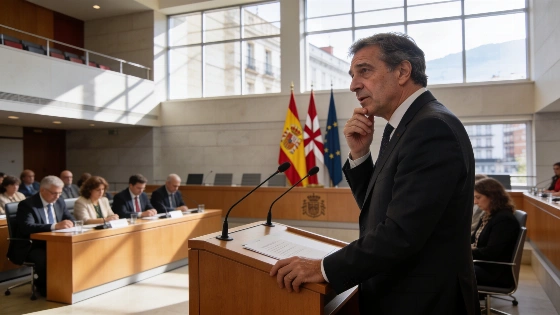
Juan Mari Aburto is set to step down after twelve years as Bilbao's mayor. In his final months, he reflects on both achievements and setbacks, urging stronger efforts to address poverty and rising crime as the city prepares for new leadership.
"I leave with scars, but also with pride." With that, Juan Mari Aburto broke from the usual script at Bilbao’s annual state-of-the-city session, turning a routine event into a frank farewell. Eight months before he steps down, the outgoing mayor used his last major address to face the city’s unresolved problems and defend his record after more than a decade in office.
Aburto didn’t gloss over the city’s biggest worries. He acknowledged that crime—especially theft and repeat offenses—has become a growing concern for residents. He credited the local police for improving their work, but insisted that new laws are needed to tackle repeat offenders directly. "We cannot look away," he said, urging continued investment to keep the police force at 900 officers and calling for a coordinated response from all levels of government.
In 2025, Bilbao's 84 public elevators and 20 ramps served 23.6 million trips, making it the Spanish city with the highest number of lifting devices, according to municipal data.
Poverty and homelessness drew his sharpest appeal. Aburto argued that Bilbao cannot be left to handle social hardship alone. He called on the Basque Government, the provincial administration, and Madrid to share responsibility, pointing to what he sees as a growing imbalance in social services. "Helping those who suffer most is everyone’s task," he said, making it clear that the city’s resources have limits. A recent regional housing review, updated in September 2026, shows ongoing pressure on the social housing market in the Basque Country—context for Aburto’s concerns about rising vulnerability and the strain on social services.
Looking back, Aburto pointed to concrete changes: the expansion of public elevators from 20 to 84, making Bilbao the Spanish city with the most lifts per capita; a drop in unemployment; the removal of Francoist symbols; and renaming streets to honor more women. He credited these changes to "commitment and dedication," not just from himself but from cross-party cooperation and a stable coalition with the PSE. "If I am remembered as the mayor of the elevators, I will smile," he said, framing accessibility as a symbol of his people-first approach. City officials have linked this infrastructure to "universal mobility," and, as reported by Deia, Bilbao expects to surpass 209 million public transport journeys in 2025—making accessibility a central theme of Aburto’s time in office.
His speech was not a victory lap. Aburto said he is "as self-critical as anyone," though he didn’t list specific mistakes. He recalled his path through Basque politics—from confronting terrorism in the regional government to building social protections in the provincial council—before returning to lead Bilbao through a period of change. "My story in politics is part of this country’s story," he said, describing his tenure as both personal and part of a larger history.
In September 2026, accessibility and support for vulnerable groups, including the elderly, were highlighted as central issues in Bilbao’s regional agenda, particularly during the city’s mobility week. This focus reflects the ongoing commitment to social and physical accessibility as Aburto’s term comes to a close.
With the PNV naming Mikel Hidalgo as its candidate for the 2027 elections, Aburto’s departure is set. He urged his team and the opposition to keep working for a "better Bilbao" in the months ahead, listing unfinished projects: rebuilding the Antón de Artxanda restaurant, the Pike adventure park, the special Ría plan, and a new tram stop at Paseo de los Caños. He also promised the completion of the Zorrozaurre storm tank redevelopment and the new Ribera Park. Local media and Aburto’s own statements in September 2026 confirm that his decision to step down in 2027 was planned, not sudden, and had been part of the city’s political agenda for weeks, with the mayor emphasizing the many projects still ahead.
Aburto ended with a warning about the rise of far-right rhetoric in Europe and Spain. Using the story of Little Red Riding Hood, he said "some caperucitas have been opening the door wide for the wolf," a pointed reference to political actors willing to trade principles for power. "Not everything goes," he said, drawing a line against sacrificing social rights and respect for short-term gain.
Aburto’s legacy is complicated. He leaves behind a city changed in visible ways, but also one still facing social divides and new political uncertainty. His focus on humility, humanity, and shared responsibility is a reminder that leadership is measured not just by achievements, but by the willingness to face hard truths. As Bilbao prepares for new leadership, the real test will be whether his successors take that lesson—or repeat the mistakes he was willing to name, even if he couldn’t always solve them.