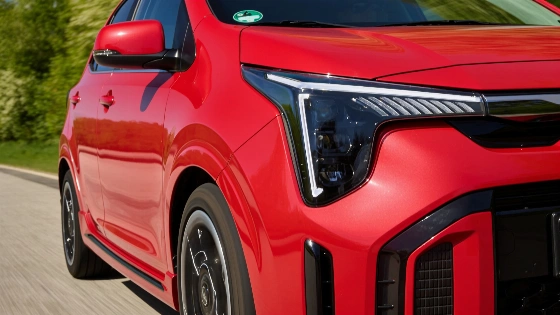
The Kia Picanto 1.0 GDI now starts above €17,000, challenging the idea that small cars mean small prices. Despite the higher cost, its durability, comfort, and features keep it relevant for city drivers.
At just 3.61 meters long, the Kia Picanto 1.0 GDI GT-Line arrives with a price tag that would have seemed unthinkable for a city car a decade ago. The tested version, with its sportier trim, starts at over €20,000—more than many expect for a compact hatchback with a naturally aspirated three-cylinder engine producing 68 hp. While this powertrain may feel dated compared to turbocharged rivals, its reputation for reliability and longevity remains a key selling point. For buyers willing to trade brisk acceleration for peace of mind, the Picanto stands out as a car built to last.
Performance and Efficiency
On paper, the Picanto’s acceleration figures are modest: 0 to 100 km/h takes 14.6 seconds, and overtaking from 60 to 100 km/h in fourth gear requires at least 14 seconds. In fifth gear, the same maneuver stretches to 21.1 seconds, and accelerating from 80 to 120 km/h in top gear takes a lengthy 25.2 seconds. Clearly, this is not a car for those seeking quick responses on the open road. However, the manual gearbox is a highlight—its smooth, precise action makes city driving engaging and helps avoid the wear issues sometimes seen in automated manual transmissions.
Fuel economy is another area where the Picanto holds its own. According to AUTO BILD’s mixed-cycle tests, the three-cylinder engine averaged 6.0 liters per 100 kilometers, using its 35-liter tank to deliver a range of around 583 kilometers between fill-ups. While not class-leading, this figure is competitive for the segment and supports the Picanto’s role as a practical daily driver.
Ride, Handling, and Comfort
Inside, the Picanto’s hard plastics are well assembled, minimizing rattles even on rough surfaces. The conventional suspension—MacPherson struts up front and a torsion beam at the rear—does transmit road imperfections into the cabin, but the structure feels solid. The steering lacks feedback, making it harder to feel fully connected to the car in corners, yet the Picanto’s traction and precision remain reassuring. Its turning circle, at 11 meters, is surprisingly wide for such a small car, and braking from speed takes 38 meters with warm discs—acceptable, though not outstanding, after repeated stops.
Long-Distance Usability
For longer journeys, the GT-Line’s sporty seats provide good lateral support and maintain comfort over extended distances. Taller drivers may find the seat’s limited fore-aft adjustment restricts legroom, but for most, the front seats are accommodating. Rear passengers, however, face a tighter squeeze, with limited space making the back seats less suitable for adults on longer trips. The boot offers 255 liters of capacity with the rear seats up, expanding to 1,010 liters when folded—ample for a car of this size.
Interior and Technology
The Picanto’s cockpit is straightforward and user-friendly, with physical controls that make daily operation intuitive. The 8-inch central display is not the largest, but wireless Apple CarPlay and Android Auto integration ensure modern connectivity. The manual climate control and a suite of advanced driver aids—including forward collision warning with turning function, active blind spot assist, rear cross-traffic alert with emergency braking, and six airbags—help justify the higher price point. Every Picanto also comes with a seven-year warranty, reinforcing its value proposition.
For those comparing options, it’s worth noting how the Picanto’s approach contrasts with larger, more expensive models like the Mercedes GLC 400 EQ 4Matic, which focuses on luxury and electric performance, as explored in this recent review of Mercedes’ electric SUV.
Final Thoughts
The era of the “cheap small car” is over, and the Kia Picanto 1.0 GDI is no exception. Its price may surprise, but the combination of proven reliability, a long warranty, and a well-equipped interior keeps it relevant for urban drivers who value durability and peace of mind. While it won’t win any drag races, the Picanto remains a dependable companion for daily life in the city.
Contextually, the Picanto’s pricing reflects a broader trend in the European car market, where safety, emissions standards, and technology have pushed up costs across all segments. For buyers prioritizing longevity and practicality over outright performance, the Picanto continues to make a strong case.