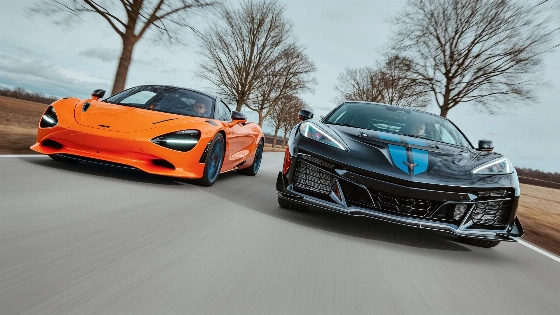
The McLaren 750S and Chevrolet Corvette ZR1 represent two extremes in the world of mid-engine supercars. British precision meets American muscle in a duel that redefines what’s possible behind the wheel.
Karl Geiger’s latest feat brings the Chevrolet Corvette ZR1, a rare American powerhouse, to European roads. With 1,079 hp and 1,123 Nm of torque, this is the most potent model ever to leave Bowling Green, Kentucky. While an even wilder hybrid version exists, the ZR1 in its pure combustion form channels all its fury through a mid-mounted V8 and rear-wheel drive, wrapped in an aluminum chassis.
Settling into the ZR1, the first impression is its sheer scale and presence. The cockpit is dominated by three digital screens, but it’s the sudden flash of orange in the mirror—a McLaren 750S—that signals the real contest. Both cars share a mid-engine layout, but their philosophies diverge sharply. The Corvette is unapologetically bold: wide, muscular, and engineered for maximum impact. Its cooling system dominates the front, while a massive splitter and rear wing generate up to 500 kg of downforce at top speed, keeping the car glued to the tarmac.
American Muscle Unleashed
Behind the wheel, the ZR1’s elevated driving position and modest lateral support feel unusual at first. But any doubts vanish when the throttle opens. The 5.5-liter twin-turbo V8 delivers a surge of power from 3,000 rpm, launching the car forward with a force that leaves little time for second thoughts. The sound is omnipresent—distinct from a classic V8, but no less commanding. Michelin Cup 2 R tires struggle to keep up as the digital rev counter races past 7,000 rpm. Braking is handled by a formidable set of Alcon six-piston ceramic brakes, with pedal feel adjustable via the touchscreen.
Performance figures are staggering: the Corvette ZR1 covers the quarter mile in just 10.16 seconds, with Chevrolet claiming it could dip below ten. The sensation is one of relentless excess, where the limits of acceleration seem to blur the line between thrill and intimidation.
British Precision in the McLaren 750S
Climbing into the McLaren 750S is a different experience entirely. Optional bucket seats, reminiscent of GT3 race cars, integrate the driver into the cockpit. The 4.0-liter twin-turbo V8 fires up with a shudder before settling into a refined idle. Every control feels precise, from the rapid-fire dual-clutch gearbox to the paddle shifters that respond instantly. The engine revs eagerly past 8,000 rpm, with turbo whistles and exhaust crackles adding to the drama, especially in Track mode.
On the move, the McLaren’s lighter weight—276 kg less than the Corvette—translates into sharper handling and greater agility. While the ZR1 dominates in straight-line speed, the 750S excels in corners, its active rear wing rising to meet the wind as it chases the American rival. The contrast between the two is stark: the Corvette overwhelms with brute force, while the McLaren rewards finesse and confidence at the limit.
Supercar Rivalry on the Road
Both cars are engineered for extremes, but their personalities couldn’t be more different. The Corvette ZR1 is a celebration of American engineering excess, demanding respect and attention at every turn. The McLaren 750S, by contrast, channels British racing heritage into a package that feels both sophisticated and brutally effective. For those who crave the ultimate driving experience, either car delivers sensations that far exceed what public roads can safely contain.
For readers interested in how automakers are reimagining compact electric vehicles for urban life, the recent Citroën Ami collaboration with Rip Curl offers a striking contrast to the raw power of these supercars, highlighting the diversity of innovation in today’s automotive world.
Context and Perspective
Mid-engine layouts, once reserved for exotic brands, are now redefining performance benchmarks across continents. The Corvette’s move to a mid-engine platform marks a historic shift for American sports cars, while McLaren continues to refine its formula for track-inspired road cars. Both models underscore a broader trend: the relentless pursuit of speed, control, and emotion, even as the industry moves toward electrification. For enthusiasts, the choice between British precision and American muscle has never been more compelling—or more difficult.