Mercedes and Audi have launched new generations of their compact SUVs, each pushing boundaries in design, technology and electrification. The GLA arrives with up to 654 km electric range, while the Q3 offers a broader engine lineup and more cargo space.
Mercedes has introduced the latest GLA, a model that has become the brand’s top seller with over 6,000 units delivered in just seven months. The new generation brings a more muscular exterior, a fully digital interior, and a lineup focused on electrification. For now, only electric versions are available, with combustion engines set to join in 2027.
The Audi Q3, meanwhile, enters its new era as a cornerstone for the four-ringed brand. Since its debut in 2011, the Q3 has sold 2.7 million units globally and remains Audi’s best-selling model this year, with sales up nearly 27% compared to last year. The new Q3 features a sharper design, advanced digital cockpit, and a wider range of powertrains, including petrol, diesel, and plug-in hybrid options.
The premium compact SUV segment has become the true battleground for German automakers, where every inch of cargo space and every kilometer of electric range now defines brand leadership.
Design and Interior
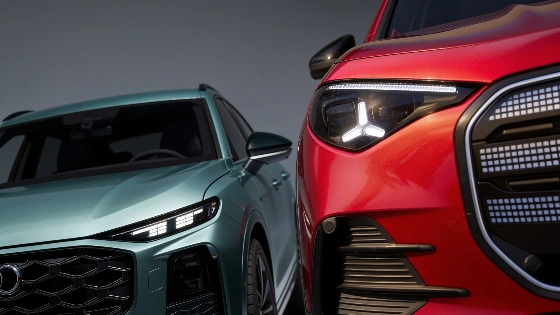
The Mercedes GLA now measures 4.56 meters long, 1.87 meters wide, and 1.60 meters high, with a wheelbase of 2.79 meters. Its electric variants start at €54,726. The front grille on battery-powered models stands out with a smoked glass effect and 608 illuminated points, while other versions use a grille with 150 chrome stars and a LED frame. Inside, the GLA adopts the MBUX Superscreen, combining three displays: a 10.25-inch instrument cluster, a 14-inch central screen, and a 14-inch passenger display. The infotainment system integrates AI-powered assistants using ChatGPT, Microsoft Bing, and Google Gemini, offering natural conversation and advanced navigation support.
Passenger space has improved, with 7 mm more legroom in front and 38 mm extra in the rear. The panoramic roof, now standard, increases headroom throughout. However, the GLA’s boot is limited to 410 liters—below average for its class—though folding the rear seats expands capacity to 1,400 liters. Electric versions add a 107-liter front trunk.
The Audi Q3 is slightly shorter at 4.53 meters long, 1.86 meters wide, and 1.59 meters high, with a 2.68-meter wheelbase. Prices start at €48,530. The new Singleframe grille and slimmer headlights give it a modern look, while the illuminated four-ring logo at the rear adds a distinctive touch. Inside, the Q3 features two digital screens: an 11.8-inch instrument panel and a 12.8-inch infotainment display. The dashboard feels more traditional compared to the GLA’s triple-screen setup. Rear seat space is adequate, but not as generous as the Mercedes, though an optional sliding bench can help adjust legroom. The Q3’s boot offers 488 liters—significantly more than the GLA—and can reach 575 liters with the sliding bench. The plug-in hybrid version, however, drops to just 375 liters.
Engines and Electric Range
The GLA’s electric lineup includes three versions: the entry-level GLA 200 electric (224 hp, 58 kWh LFP battery, not yet on sale), the GLA 250+ electric (272 hp, 85 kWh NMC battery, up to 654 km range), and the GLA 350 4MATIC electric (354 hp, dual motors, all-wheel drive, up to 640 km range). Thanks to its 800-volt architecture, the GLA can recover up to 270 km of range in just ten minutes at 320 kW fast chargers, and charges from 10% to 80% in 22 minutes. Combustion engines, arriving in 2027, will use a 1.5-liter four-cylinder petrol engine from Geely, paired with a 48V mild hybrid system and a new eight-speed dual-clutch automatic gearbox.
The Audi Q3 offers a broader selection: a 1.5-liter TFSI petrol engine with 150 hp (mild hybrid, ECO label), 2.0 TFSI petrol engines with 204 or 265 hp (C label), a plug-in hybrid Q3 e-hybrid with 272 hp and up to 120 km electric range (CERO label), and two 2.0 TDI diesel options with 150 or 193 hp. This variety allows buyers to choose between traditional combustion, hybrid, and plug-in hybrid powertrains, though a fully electric Q3 is not available—Audi reserves that for the larger Q4 e-tron.
Technology and Practicality
Both models push the envelope in digitalization and comfort. The GLA’s triple-screen dashboard and AI assistant set a new standard for in-car tech, while the Q3’s dual-screen setup remains intuitive and familiar. The GLA offers more legroom and headroom, but the Q3 wins on cargo space and flexibility, especially with its sliding rear bench. For families or those needing more luggage capacity, the Audi holds a clear advantage.
When it comes to charging and electric range, the GLA stands out with its rapid charging capability and long-range battery, making it a strong option for those prioritizing electric mobility. The Q3’s plug-in hybrid, meanwhile, offers a practical compromise for drivers who want electric range for daily commutes but the reassurance of a combustion engine for longer trips.
Which SUV Stands Out?
Choosing between the Mercedes GLA 2026 and the Audi Q3 depends on priorities. The GLA leads in electric innovation and digital experience, but its boot is smaller and combustion versions are not yet available. The Q3 is more versatile, with a wider engine range and greater practicality, though it lacks a full-electric option. For those seeking a premium electric SUV with cutting-edge tech, the GLA is hard to ignore. For buyers valuing flexibility, cargo space, and a broader choice of engines, the Q3 remains a benchmark.
As the premium SUV segment evolves, German brands are intensifying their efforts to stay ahead of new competitors. The arrival of models like the MG 07, which has drawn attention for its Porsche-inspired design and aggressive pricing, as covered in our recent analysis of the changing landscape in the premium segment, highlights how the market is shifting. For now, Mercedes and Audi continue to set the pace in technology and refinement, but the competition is only getting stronger.