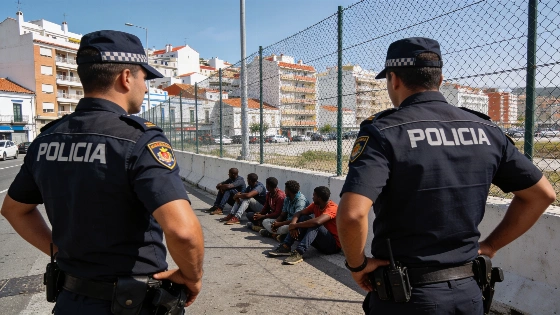
The migration crisis in Ceuta has pushed immigration to the top of Spain’s political agenda. Vox is capitalizing on the situation, with polls showing a clear rise. The government faces mounting pressure as the debate grows more polarized.
Immigration has become the central issue in Spanish politics following the ongoing crisis in Ceuta. For nearly a month, the topic has dominated headlines, political debates, and social media, with terms like “saturation” and “invasion” shaping public perception. The situation remains unresolved, and the political landscape is shifting as Vox, Spain’s far-right party, emerges as a key beneficiary of the heightened focus on migration.
Academic research across Europe has consistently shown that when media attention on immigration intensifies—especially in connection with conflict or emergency—hardline anti-immigration parties tend to gain support. This pattern, observed in multiple countries, is now evident in Spain. Experts note that when a political issue rises in importance, the party most clearly associated with it often reaps the rewards, regardless of perceived competence. As the new political season begins, Spain’s debate is set within a framework that favors the far right.
The rise of the far right across Europe has often coincided with spikes in migration-related news, notably during the 2015 Syrian refugee crisis. In the UK, Nigel Farage recently secured a renewed mandate amid ongoing investigations, while parties like Reform UK, Hermanos de Italia, Reagrupamiento Nacional in France, and Alternativa para Alemania lead or challenge for the top spot in polls. In Spain, Vox holds third place with around 17% support, but its fortunes have improved as immigration has become a top concern. After breaking regional alliances with the PP in July 2024 over the handling of unaccompanied minors from the Canary Islands, Vox has sharpened its anti-immigration stance, launching high-profile initiatives such as advocating for “national priority.”
Recent data from the CIS shows that immigration is now seen as Spain’s second most serious problem, just behind housing. During the peak of the Canary Islands crisis in September 2024, the share of respondents naming immigration as a top-three issue jumped from 16.9% to 30.4%. Vox’s polling numbers climbed in parallel, reaching historic highs after the government announced a large-scale regularization of migrants. Analysts expect this trend to continue if the issue remains prominent.
Experts in political communication argue that the current media coverage—marked by images of unrest and uncertainty—creates fertile ground for parties like Vox. When the narrative centers on threats and problems, anti-immigration actors are well positioned to benefit. However, the impact is not automatic; other factors can limit far-right gains. The Ceuta crisis, with its mix of migration, geopolitics, and national sovereignty, echoes previous emergencies such as the 2020 Greek-Turkish border standoff, making anti-immigration messages harder to counter.
Research suggests that when voters view immigration as a top political issue, their likelihood of supporting radical right parties increases. Even when mainstream parties attempt to address migration with alternative narratives, they may inadvertently reinforce the topic’s importance, further benefiting parties that specialize in the issue. This dynamic was highlighted in the run-up to the 2024 European elections, when the European Parliament’s migration pact, intended to undercut the far right, instead made immigration the campaign’s central theme and contributed to far-right gains.
Vox’s strategy relies on mobilizing emotions and framing migrants as an external threat. The government, meanwhile, has struggled to present a strong narrative or project unity in the face of the crisis. Critics argue that Prime Minister Pedro Sánchez missed an opportunity to rally the country around a firm response, especially as Morocco’s role in the crisis remains a sensitive point. The perception that the government has softened its stance, while the right projects strength, has shifted the balance of the debate.
Within the right, competition over who can appear toughest on migration is intensifying. PP leader Alberto Núñez Feijóo has echoed Vox’s calls for mass expulsions, including of minors, despite legal barriers. Some analysts warn that by adopting Vox’s rhetoric, the PP risks inflaming public demand for hardline measures and then disappointing voters with more moderate policies. At the same time, the PP could benefit if it manages to shift the debate toward government control of borders rather than crime or insecurity, positioning itself as the experienced alternative.
For additional context on how local leaders are navigating high-profile issues, see how Vigo’s mayor recently positioned the city in the national spotlight by promising a larger stage for a major international artist in this recent report.
Spain’s migration debate is now at a critical juncture. The Ceuta crisis has not only exposed deep divisions over immigration policy but also highlighted the political risks for both government and opposition. As the situation evolves, the outcome will likely shape the country’s political direction and influence broader European trends. The focus on migration is expected to persist, with potential consequences for party strategies, public opinion, and Spain’s role in managing future migration flows. Understanding the interplay between media coverage, political messaging, and public sentiment is essential for anticipating the next phase of this ongoing crisis.