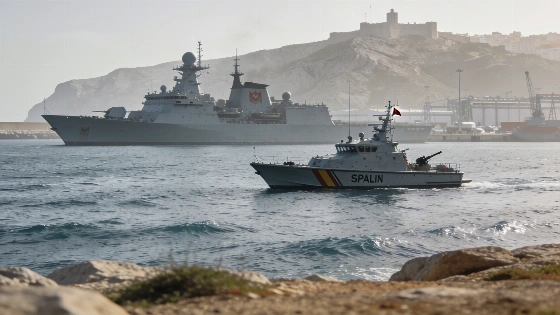
Moroccan naval vessels entered waters claimed by Spain during the July migrant crisis. Spain sent warships to Ceuta after repeated incursions reportedly brought patrol boats close to a collision.
On 3 August, the Buque de Acción Marítima, or BAM, Rayo reached Ceuta from Las Palmas de Gran Canaria. The deployment followed a reported confrontation in which Moroccan warships entered waters claimed by Spain during the mass arrival of migrants.
According to the investigation described in the original account, at least one frigate and several Royal Moroccan Navy patrol boats crossed into Ceuta’s territorial waters without requesting permission. Independent reporting confirms the scale of the land migration crisis. It does not independently verify the ships’ routes, manoeuvre dates or alleged military negotiations. Those maritime details remain findings and claims from the source investigation.
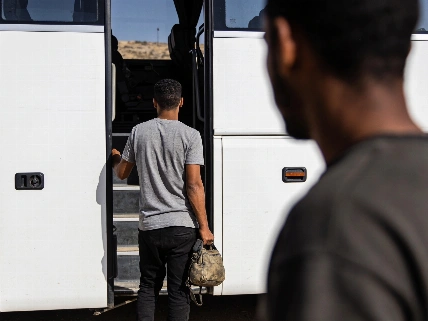
More than 70,000 migrants crossed from Morocco into Ceuta on foot and by swimming through the El Tarajal crossing on 30 and 31 July. Some estimates reached approximately 80,000, although most people returned to Morocco within several days.
The vessels in the maritime episode were military ships acting under orders. That made the reported confrontation more serious for Spain’s defence authorities than the movement of unarmed civilians across the land border.
Associated Press reported approximately 140 deaths during attempts to reach Ceuta by swimming or to bypass border barriers, making the July episode one of the deadliest incidents at the city’s frontier.
According to EL PAÍS, informed sources did not describe the entries as accidental or as ordinary passage. They characterised them as deliberate and repeated violations of Spanish sovereignty at sea. The incursions stopped after Spain deployed naval assets around Ceuta and the Ministry of Defence made high-level representations to authorities in Rabat. Available independent materials do not provide separate official confirmation of the alleged incursions.
The Rayo, based at the arsenal in Las Palmas de Gran Canaria, arrived on 3 August to strengthen surveillance around Ceuta.
Spain then sent the frigate Santa María from the Rota naval base in Cádiz. A breakdown forced its replacement by the frigate Navarra, which was also assigned to the 41st Escort Squadron. Both frigates briefly docked in Ceuta on 6 August. Marine Infantry equipment carried aboard was transferred without delaying the operation.
The land crisis did not end with the initial crossings. Estimates of the number of migrants remaining in Ceuta rose from about 2,000 in the first statements by Spain’s interior minister to 10,000 officially in September, while the city’s mayor allowed for as many as 15,000; authorities acknowledged that they lacked a precise count.
The deployment was intended to deter further incursions. Spanish naval units began patrols around Ceuta, and the Moroccan vessels subsequently abandoned the reported behaviour, according to the original investigation. During the manoeuvres, a Spanish patrol boat and a Moroccan patrol boat came close to colliding. No independent official record confirming that near-collision has been identified in the available research.
The dispute is territorial. Spain claims a 12-nautical-mile territorial sea measured from Ceuta’s coastline. Morocco rejects Spanish sovereignty over Ceuta and Melilla, which it describes as “presidios”, and rejects their surrounding waters. The maritime boundaries therefore remain internationally undelimited.
Moroccan Gendarmerie boats regularly pursue drug-smuggling speedboats in the area. The reported presence of Royal Moroccan Navy warships inside waters claimed by Spain is unusual. That difference explains why the episode, as presented by the investigation, prompted a direct military response rather than routine maritime coordination.
Ceuta lies close to Morocco’s naval base at Ksar Sghir, known in Spanish as Alcazarseguir. The facility sits around 35 kilometres west of the city, opposite the coast near Tarifa. It is the most important naval installation in northern Morocco. The Mohamed VI frigate, built in France, and Sigma-class ships constructed in the Netherlands regularly call there.
The crisis widened the security response on land. Personnel from the Ceuta Command, the Mando de Canarias, the Land Force and the CIFAS were deployed to reinforce security and reduce anxiety among residents.
Defence Minister Margarita Robles praised the operation and ordered an internal investigation after Amnesty International reported alleged mistreatment of irregular migrants by soldiers. She also referred the report to the duty court.
Humanitarian pressure continued for months. Migrants were reported living on beaches and streets. Others stayed near warehouses or at temporary sites. The city struggled particularly with the number of unaccompanied minors. The Spanish government ordered individual consideration of children’s and teenagers’ cases and allocated more than €90 million to Ceuta. Local authorities said those resources were insufficient to accommodate everyone.
In October, police supported by military personnel dismantled the El Guano camp. More than 350 police officers took part, according to reporting from Spain English and other outlets.
King Felipe VI received a detailed briefing on the military situation. On 8 September, he chaired a meeting at Zarzuela attended by Robles and senior officers responsible for operational command, including the Chief of the Defence Staff and the commander of Ceuta. The meeting was absent from the public diary. The Royal Household later disclosed it through a photograph.
The political consequences reached Madrid and the European Union. The mass arrival produced a crisis in the Spanish capital and concern across the bloc. Morocco continued to assert sovereignty over Ceuta and Melilla, territories Spain considers its own.
Reuters also reported that Morocco’s king said the existing model of migration cooperation with Spain had reached its limit. His statement pointed to wider strain in the bilateral mechanism for controlling migration.
The available evidence separates two episodes: a mass land crossing and a reported maritime challenge whose coordination has not been established. The cited sources did not speculate about a joint plan. Independent reporting establishes the scale and human cost of the migration emergency, the prolonged pressure on Ceuta’s reception system and the continuing sovereignty dispute.
The alleged naval incursions, their timing, routes and the reported near-collision remain details attributed to the original investigation. They have not been independently confirmed by several sources.