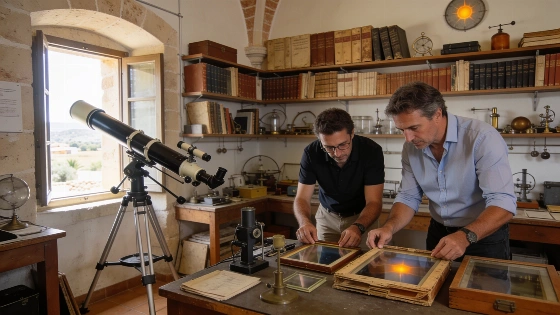
The Observatorio del Ebro, with over a century of scientific data, is set for renewed recognition as it becomes the only Catalan site in the path of the total solar eclipse. A new phase begins for the historic center.
The Observatorio del Ebro in Roquetes (Tarragona) is entering a pivotal moment as it prepares to be the only Catalan observatory directly in the path of the upcoming total solar eclipse on August 12. This rare astronomical event is not only drawing scientific attention but also prompting a shift in the observatory’s institutional status, marking a significant change for one of Spain’s oldest research centers.
Founded over 120 years ago by Jesuits who sought to advance studies in philosophy and physics, the observatory has long specialized in the complex interactions between the Sun and Earth. Its origins are closely tied to the total solar eclipse of 1905, which was documented using a distinctive golden telescope with dual tubes—one for focusing and another for capturing images on glass plates. Since then, the center has amassed one of the longest continuous series of solar and geophysical data in Europe, enabling research into solar cycles and their impact on Earth’s climate and technology.
Today, the Observatorio del Ebro operates as a research and outreach institution affiliated with the Universitat Ramon Llull and the CSIC. Its work spans meteorology, seismology, and terrestrial magnetism, with a particular focus on monitoring solar storms and assessing the vulnerability of electrical infrastructure. According to Juan José Curto, head of Scientific Culture at the observatory, the risk of severe disruptions from solar activity remains low for now, but the center’s long-term data is crucial for understanding potential threats.
Beyond its scientific output, the observatory is notable for its extensive material and immaterial heritage. It houses a collection of historic instruments, including a Rowland spectrometer, and maintains a library of more than 50,000 books, journals, and technical drawings. This archive, built through decades of international data exchange, supports studies on long-term solar and climate trends, including records dating back to the industrial revolution.
After nearly a century under Jesuit management, the observatory transitioned a decade ago to a board led by the Generalitat de Cataluña. Recently, its oversight was moved from the Department of Territory to the Department of Research and Universities, signaling a new phase for the institution. Curto notes that while the core research lines will continue, the change could open doors to new opportunities and projects that were previously out of reach.
Historically, the Observatorio del Ebro has operated in the shadow of other Catalan centers, such as the Fabra Observatory in Barcelona and the Montsec Observatory in Lleida. However, the upcoming eclipse is expected to raise its profile both within the scientific community and among the public. The Generalitat has designated the site as the official observation point for the event, and a series of public workshops and specialized conferences are planned, including a gathering of the International Astronomical Union focused on solar observation and data preservation.
On the day of the eclipse, a series of live-streamed talks will feature prominent figures such as Vatican Observatory astronomer Pavel Gabor, Nobel laureate Didier Queloz, and astronauts Ellen Baker and Pedro Duque. These activities aim to highlight the observatory’s enduring relevance and its role in advancing solar research.
Interest in the eclipse is high across Catalonia, with authorities preparing for a surge in visitors and related events. As noted in recent coverage of Catalonia’s preparations for the eclipse, local institutions are coordinating security, health, and mobility plans to manage the influx and ensure safe viewing conditions.
The Observatorio del Ebro’s unique position—both geographically and institutionally—underscores its renewed importance. Its vast archives and historic instruments offer a window into more than a century of scientific progress, while its current transformation reflects broader changes in how Spain values and supports its scientific heritage. As the eclipse approaches, the observatory stands ready to reclaim its place on the map, both as a center of research and as a guardian of scientific memory.
For context, the Observatorio del Ebro is one of the few institutions in Spain with uninterrupted solar and geophysical records spanning more than a century. Its data is vital for understanding long-term solar cycles, which can influence everything from climate patterns to the stability of modern power grids. The observatory’s integration into the Department of Research and Universities may facilitate greater collaboration with academic and governmental bodies, potentially leading to new research initiatives and public engagement projects. The upcoming eclipse serves as both a scientific opportunity and a catalyst for institutional renewal, highlighting the enduring value of historical observatories in the era of space weather and climate research.