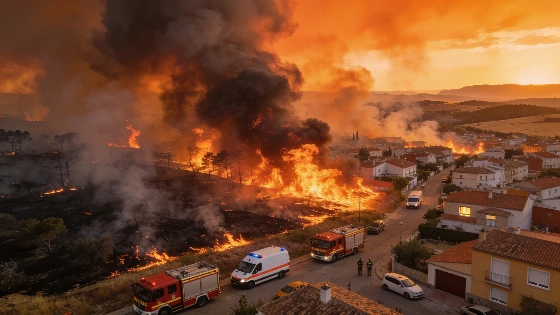
A major wildfire in Madrid has forced the confinement of more than 20,000 people. Ten towns have been evacuated, while four remain under strict stay-at-home orders. Authorities warn the situation is still unstable.
More than 20,000 residents in Madrid’s Sierra Oeste remain confined to their homes as a massive wildfire continues to burn out of control, with authorities unable to stabilize the situation. The fire has already destroyed 45,000 hectares, prompting the evacuation of ten municipalities and the displacement of around 30,000 people. Four towns—San Martín de Valdeiglesias, Pelayos de la Presa, Valdemaqueda, and Villa del Prado—are still under strict stay-at-home orders, with local police and emergency services urging residents to avoid going outside due to heavy smoke.
In San Martín de Valdeiglesias, the atmosphere is tense but calm. Residents report that while flames are not visible from the town, thick smoke remains the main concern. Local authorities have set up a municipal pavilion to shelter evacuees from nearby areas. According to officials, the decision to confine or evacuate is based on technical assessments by Protección Civil, depending on the fire’s progression and wind direction. When a confinement order is issued, the Ministry of the Interior sends Es-Alert notifications to affected residents, making it mandatory to stay indoors.
Emergency teams emphasize that confinement is often the default measure, aiming to prevent unnecessary movement, reduce panic, and limit exposure to smoke—especially for vulnerable groups like the elderly. Firefighters note that most Spanish homes, built from stone or brick, offer significant protection against fire, making it safer for residents to remain inside unless evacuation is explicitly ordered. In Pelayos de la Presa, business owners describe a paralyzed town, with many second-home residents having already left. Those who remain face uncertainty and economic hardship, as local commerce grinds to a halt.
Some residents, like a mother in Villa del Prado, chose to leave before official orders, seeking refuge with relatives due to the overwhelming smoke and falling ash. However, emergency services caution against self-evacuation, warning that leaving by car when fire is near can be more dangerous than staying indoors. Firefighters stress that evacuations require careful planning and are never carried out at the last minute. When towns are fully evacuated, emergency crews can focus on containment without the added risk of assisting panicked residents.
As the situation develops, the main priority remains the safety of those still confined. The ongoing crisis in Madrid’s Sierra Oeste has drawn national attention, with previous incidents in the region highlighting the challenges of wildfire management. For example, a recent large-scale evacuation in southwest Madrid underscored the impact of extreme weather and the complexity of coordinating emergency responses.
Spain’s wildfire season has become increasingly severe in recent years, with rising temperatures and prolonged droughts contributing to more frequent and intense blazes. The current emergency in Madrid demonstrates the importance of rapid decision-making and clear communication between authorities and residents. While the immediate focus is on containment and public safety, the long-term recovery for affected communities will depend on continued support and effective disaster management strategies. The events in Sierra Oeste serve as a stark reminder of the growing risks posed by wildfires across the country.