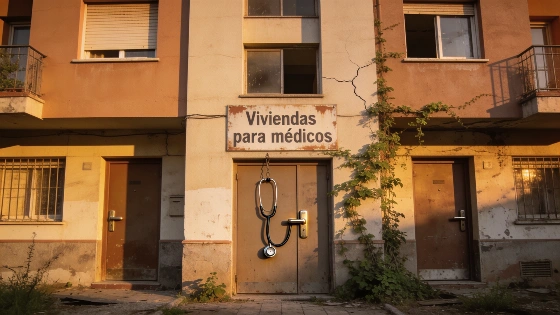
A year after Pinto’s mayor pledged free homes to attract doctors, the apartments remain closed. The plan aimed to address a critical shortage of medical staff. Vulnerable families have also lost access to these social flats.
In Pinto, a much-publicized plan to offer free municipal housing to doctors has stalled, leaving eight apartments empty a year after the announcement. The initiative, launched by Mayor Salomón Aguado (PP) in June 2025, was intended to attract medical professionals to a municipality struggling with severe staff shortages in its health centers. Despite initial enthusiasm and candidates from as far as Córdoba and Tenerife, the apartments remain locked, and there is still no timeline for when doctors might move in.
The urgency behind the measure is clear: Pinto’s two health centers serve over 56,000 residents and are officially classified as “difficult to staff” by the regional health authority. Even with financial incentives—€500 for doctors and pediatricians, €280 for nurses—vacancies persist. A third health center, long demanded by locals, is under construction but not expected to open before the end of the year. The town’s out-of-hours care post (PAC) has also faced criticism for chronic understaffing, though official data claims full coverage for nurses and orderlies, and 75% for doctors.
The housing plan itself has become a point of contention. Originally, six municipal flats were to be offered to doctors under a free-use agreement, with only utility costs to pay. The number was later increased to eight. These apartments were reclassified from the town’s pool of 32 social housing units, a move that required them to be removed from the public housing register and designated as municipal assets. This decision, pushed through by the PP, Vox, and Pinto Avanza coalition in January 2026, was opposed by Más Madrid and PSOE, who argued it deprived vulnerable families of much-needed affordable housing.
Local opposition has highlighted the trade-off between healthcare access and social housing. Más Madrid’s Elena Ancos points out that Pinto has far more families in need than available social flats. The town hall, however, insists there is no waiting list, citing the absence of an open application process. Nearly a year after the mayor’s promise, the eight apartments remain unused, benefiting neither doctors nor families in need. The municipal spokesperson maintains that the administrative process is ongoing, with a target of 2026 or possibly 2027 for completion. Financial constraints may be a factor, as Pinto is currently under a mandatory Economic and Financial Plan due to budgetary compliance issues, though officials deny the town is in the red.
The Pinto model has drawn attention beyond the municipality. The regional government, led by Isabel Díaz Ayuso, has announced the Plan Vive Sanitario, inspired by Pinto’s approach. This new scheme will offer 120 affordable rental homes—not free, unlike Pinto’s plan—to healthcare professionals under 35 in San Sebastián de los Reyes. The project will use a public-private partnership model and is part of a larger plan to build 1,000 new apartments in the area, though details remain scarce. The medical union Amyts has expressed skepticism, viewing such measures as temporary fixes that do not address the underlying issue: medical salaries that make housing unaffordable in many parts of Madrid.
Across Spain, similar tensions have emerged as local governments try to balance social needs and public services. For example, Catalonia recently allocated €30 million to identify families missing out on social aid, aiming to reduce child poverty by expanding welfare access—a move that highlights the broader challenge of supporting vulnerable groups while addressing staffing shortages in essential services. More on this can be found in the report on Catalonia’s investment in reaching underserved families.
As of mid-2026, Pinto’s free housing for doctors remains a promise unfulfilled. The apartments stand empty, with no clear date for when they will be occupied. The situation underscores the complexity of local policy decisions, where efforts to solve one crisis can deepen another, and where administrative and financial hurdles often delay even the most celebrated initiatives.