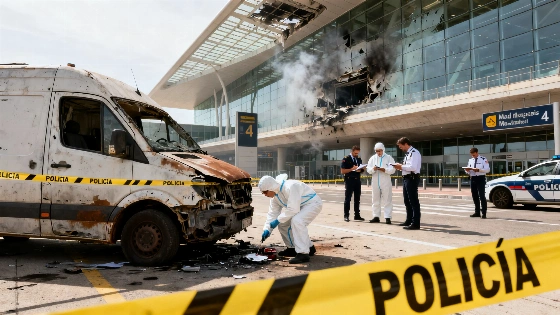
A fresh police report has reignited the investigation into four ex-ETA leaders for the 2006 T-4 bombing. The document highlights the executive committee's key role. The case could set a precedent for prosecuting ETA's former leadership.
The investigation into the 2006 bombing at Madrid-Barajas airport’s Terminal 4 has gained new momentum after the National Police submitted a detailed report to the Audiencia Nacional. The document, delivered to Judge Francisco de Jorge, outlines how only the executive committee of ETA, known as Zuzendaritza Batzordea (Zuba), had the authority to order such an attack during ongoing negotiations with the Spanish government. This renewed focus comes as the case, originally opened in January 2022, targets four former ETA leaders suspected of orchestrating the deadly operation.
According to the police report, the Zuba’s members were the only ones capable of authorizing the placement of the van bomb that killed Diego Armando Estacio and Carlos Alonso Palate, injured around twenty people, and caused extensive material damage. The attack also marked the abrupt end of peace talks between ETA and the government led by José Luis Rodríguez Zapatero. The victims’ association Dignidad y Justicia (DyJ) has been instrumental in pushing for legal action, filing a complaint against Jose Antonio Urrutikoetxea (Josu Ternera), Mikel Carrera Sarobe (Ata), Ainhoa Ozaeta (Kuraia), and Airtzol Iriondo (Gurbitz), all believed to have been part of ETA’s executive committee at the time.
The police report, spanning 176 pages, identifies eight individuals as members of ETA’s leadership in the three months leading up to the T-4 bombing. Alongside the four initially named by DyJ, the report adds Garikoitz Aspiazu (Txeroki), Francisco Javier López Peña (Thierry), Igor Suberbiola, and Iratxe Sorzabal. Notably, Thierry is reported to have died in 2013, extinguishing any criminal responsibility. The document emphasizes ETA’s rigid, hierarchical structure, describing it as almost military in nature, with strict discipline and centralized decision-making. Operational commands, the report notes, acted solely as instruments of the leadership’s strategy, with the Zuba responsible for planning, coordination, and authorization of attacks, especially those deemed “special operations” like the T-4 bombing.
Evidence cited in the report includes references to a 2006 meeting in Navarra, where two senior ETA leaders allegedly instructed three operatives to carry out the Barajas attack. The police analysis suggests the bombing was ETA’s response to what it saw as stalled negotiations and perceived government breaches. The leadership later justified the attack in an internal publication, Zutabe 112, outlining its rationale and the context of the failed talks.
Efforts to hold ETA’s former leaders accountable have intensified in recent years, despite the group’s dissolution and a sharp decline in related court cases. DyJ and specialized police units have worked to prevent these crimes from expiring under statutes of limitations, leading to the reopening of several cases against more than twenty ex-leaders. The prevailing legal argument is that ETA’s strict hierarchy meant no significant action occurred without the executive committee’s knowledge or approval. Orders were relayed through a clear chain of command, reinforcing the case for holding top leaders responsible for attacks carried out by subordinates.
Recent judicial decisions reflect this approach. In January 2025, Judge Francisco de Jorge charged five ETA leaders with responsibility for the 1995 murder of Gregorio Ordóñez, attributing to them accountability for all attacks committed during their tenure in the executive committee. Other rulings have echoed this logic, including cases involving the killings of Francisco Arratibel and Miguel Ángel Blanco, where judges highlighted the leadership’s decisive role in selecting high-profile targets and directing operations.
ETA, or Euskadi Ta Askatasuna, was a Basque separatist group responsible for hundreds of deaths over several decades. The T-4 bombing in 2006 was a turning point, ending a ceasefire and peace process. Since ETA’s official disbandment in 2018, Spanish authorities have continued to pursue unresolved cases, focusing on the legal doctrine of indirect perpetration by command. The outcome of the current investigation could influence future prosecutions of former terrorist leaders in Spain and beyond.