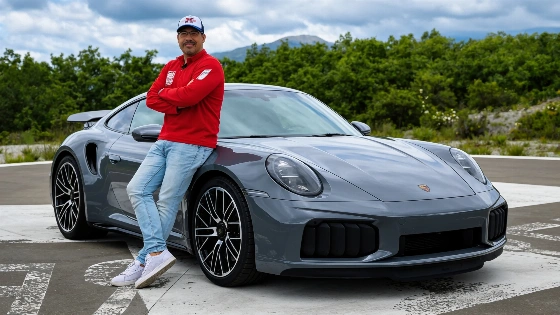
Porsche has unveiled the 911 Turbo S 2026, featuring a 711 hp T-Hybrid system, dual electric turbos and a 0-100 km/h time of just 2.5 seconds. The model blends extreme performance with daily usability and a refined interior.
Porsche has raised the bar for high-performance sports cars with the launch of the 911 Turbo S 2026. The new model debuts a 711 hp T-Hybrid system, combining a 3.6-litre twin-turbo boxer engine with two electric turbos and an eight-speed PDK transmission. This setup delivers all-wheel drive and a 0-100 km/h sprint in just 2.5 seconds, placing the Turbo S among the fastest production cars on the market.
Despite the headline figures, Porsche has focused on more than just raw power. The T-Hybrid system is engineered to enhance both performance and efficiency, using a 400-volt architecture and a compact 1.9 kWh battery. The electric turbos reduce lag and recover energy from the exhaust, while the integrated electric motor in the gearbox provides instant torque without the weight penalty of a plug-in hybrid.
The 911 Turbo S is not just about power — it's about proving that hybrid technology can enhance the soul of a sports car, not dilute it.
Design and Aerodynamics
The 911 Turbo S 2026 retains the unmistakable silhouette of the 911, but with notable changes. The car measures 4.55 meters long, 1.90 meters wide, and 1.30 meters high, with a wheelbase of 2.45 meters. The front fenders are 45 mm wider than those of the Carrera, and the rear gains an extra 20 mm. Active vertical slats, a redesigned front diffuser, and a mobile rear wing all contribute to improved aerodynamics. Depending on speed and cooling needs, these elements adjust to reduce drag by up to 10% and channel extra air to the brakes.
Interior: Technology Meets Tradition
Inside, the Turbo S blends digital sophistication with classic Porsche ergonomics. The cabin features leather, Race-Tex, and Turbonita accents, a 12.6-inch curved digital instrument cluster, and a 10.9-inch PCM central display for navigation and media. The GT steering wheel includes a drive mode selector, and the 18-way adaptive sports seats offer memory, strong lateral support, and reduced weight. The car comes standard as a two-seater, but rear seats can be added at no extra cost, increasing everyday practicality.
Performance and Chassis
The T-Hybrid powertrain delivers 711 hp and 800 Nm of torque between 2,300 and 6,000 rpm. The dual eTurbo setup, a step beyond the single electric turbo in the Carrera GTS, ensures rapid boost and energy recovery. The Turbo S accelerates from 0 to 200 km/h in 8.4 seconds and reaches a top speed of 322 km/h. On the Nürburgring Nordschleife, it clocked a lap time of 7:03.92, shaving 14 seconds off its predecessor—a testament to the chassis' resilience despite the 85 kg weight increase from hybridization.
Standard equipment includes rear-axle steering, PCCB ceramic brakes (420 mm front, 410 mm rear), electrohydraulic ehPDCC, PASM adaptive suspension, PTV Plus torque vectoring, and center-lock wheels (20-inch front, 21-inch rear). Fuel consumption is rated at 11.5–11.7 l/100 km, with CO2 emissions between 261 and 266 g/km. The front trunk offers 128 liters of usable space, making the Turbo S surprisingly practical for a supercar.
Pricing and Rivals
The 911 Turbo S 2026 launches in Spain at €312,000 for the Coupé. While customization can quickly raise the price, standard equipment is more generous than before. In terms of competition, the Ferrari 296 Speciale (880 hp) and Lamborghini Temerario (920 hp) offer more power and dramatic styling, but the Porsche stands out for its all-wheel drive, understated design, and genuine daily usability. The Mercedes-AMG GT 63 S E Performance, with 816 hp and 1,420 Nm, leans more toward grand touring, while the 911 Turbo S strikes a balance between precision, performance, and everyday comfort.
For those following the evolution of high-performance hybrids, the Turbo S T-Hybrid represents a significant leap in technology and capability. Its approach echoes the broader shift seen in the industry, as highlighted by the transformation of classic tuners like Irmscher, who have brought racing DNA to electric SUVs such as the Leapmotor B10 Dynamic (see how performance heritage is being redefined in the electric era).
The 911 Turbo S 2026 is heavier, more complex, and more expensive than before, but it is also faster, more stable, and technologically advanced—without losing the core identity that defines the Porsche 911. This model signals not just an evolution for Porsche, but a new standard for hybrid supercars in Europe.