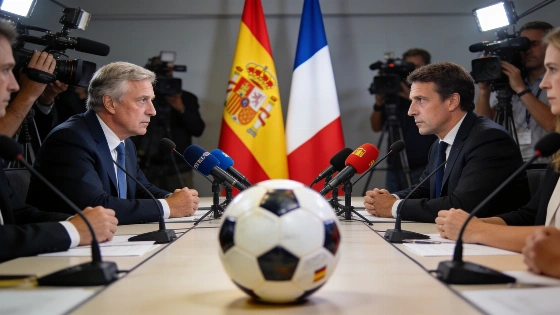
The Partido Popular has defended Mariano Rajoy after his remarks about France's football team sparked protests from French officials. The PP insists the comment was sarcastic, not malicious. Tensions rise as the debate draws in both governments.
The Partido Popular (PP) leadership has moved quickly to contain the fallout from comments made by former Prime Minister Mariano Rajoy regarding the French national football team. Rajoy, in an article for El Debate, suggested that France plays at a high level but "without Frenchmen," a phrase that triggered strong reactions from French officials and drew accusations of racism.
French government spokespersons and the Minister of Foreign Affairs, Jean-Noël Barrot, publicly condemned Rajoy's statement, emphasizing that "France has no skin color" and labeling any suggestion otherwise as either ignorance or racism. The French Embassy in Madrid also responded, clarifying on social media that all 26 players called up for the French squad are French citizens, with 23 born in France and the remaining three holding French nationality despite being born abroad.
Amid the diplomatic tension, PP spokesperson Borja Sémper defended Rajoy, insisting the remark was intended as sarcasm and carried no ill will. Sémper argued that only French nationals can play for the French team, calling this an obvious fact and attributing the tone to Rajoy's characteristic style. He urged that the comment be interpreted as a light-hearted, pro-Spanish sentiment rather than a slight against France.
The controversy has also spilled into domestic politics. Sémper criticized Prime Minister Pedro Sánchez for his neutral stance on the World Cup, where Sánchez stated he wanted "the best team to win." Sémper contrasted this with the PP's position, declaring their support for Spain regardless of performance and emphasizing national loyalty over sporting merit. He later clarified that he did not mean to suggest Spain would play poorly, seeking to avoid further misunderstandings.
This incident highlights the sensitivity surrounding national identity in international sports, especially in the context of multicultural teams like France's. The French squad has long been a symbol of diversity, with players from various backgrounds representing the country at the highest level. The debate over who is considered "truly" French has surfaced repeatedly, particularly during major tournaments. In Spain, football remains a powerful force for national unity, and political leaders often use the sport to signal broader messages about identity and belonging. The current dispute underscores how quickly sporting comments can escalate into diplomatic issues, especially when they touch on questions of race and nationality.