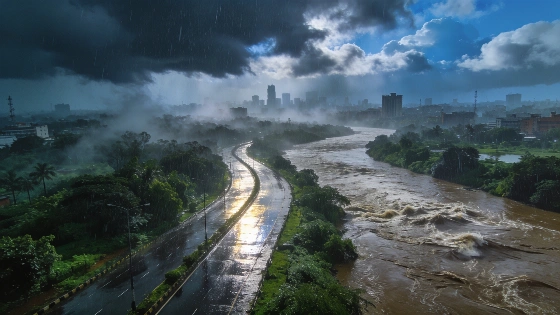
Pune has seen rainfall far above normal for early July. Authorities now expect a marked decrease in intensity. The India Meteorological Department forecasts only light to moderate rain from Wednesday.
Pune district is set for a significant shift in weather as the India Meteorological Department (IMD) signals an end to the intense rainfall that has dominated the first week of July. After days of heavy downpours, the IMD now predicts only light to moderate rain for Pune and its suburbs starting Wednesday, marking a clear break in the monsoon pattern. This change comes after the region recorded rainfall levels far exceeding historical averages, raising concerns and prompting close monitoring by local authorities.
Between July 1 and 7, Pune district accumulated 438.5 mm of rain, a figure that stands 74 percent above the typical 252.6 mm for this period, according to data from The Indian Express. Central Maharashtra has also erased its earlier rainfall deficit, with 209 mm recorded since the start of the month—just above the normal 205.8 mm. The persistent rainfall has not only affected daily life but also set new benchmarks for the region’s weather records.
Shivajinagar, a key weather station in Pune, exemplifies the scale of this year’s monsoon. On Tuesday morning, it registered 97.5 mm of rain in 24 hours, following 108.4 mm the previous day—the fourth-highest July reading since 1896. In just one week, Shivajinagar received 301.1 mm, more than the total July rainfall in most recent years. For comparison, the same station saw only 130.3 mm by the end of July last year, and similar or lower totals in 2023, 2021, 2020, and 2018. Only in 2024, 2022, and 2019 did the full month’s rainfall surpass this week’s figures.
The IMD attributes the expected reduction in rainfall to the weakening of a well-marked low-pressure area over East Madhya Pradesh and adjoining regions. As this system moves west-northwest and loses strength, the Arabian Sea branch of the monsoon is set to weaken, shifting heavier rainfall northwards and easing conditions over Maharashtra. The IMD expects a substantial drop in rain intensity within 48 hours, with the most noticeable change from July 9 onward.
Recent data from other Pune localities confirm the trend. Pashan, which saw 113 mm of rain from Sunday to Monday morning and 115.6 mm by Tuesday morning, recorded only 23 mm between 8:30 am and 5:30 pm on Tuesday—a sharp decline from the 69 mm during the same period the previous day. NDA and Lohegaon also reported much lower rainfall by Tuesday evening, with 14 mm and 9 mm respectively. Chinchwad, after being hit with 132 mm by Monday evening and 474 mm over 48 hours, saw just 13.5 mm on Tuesday. Hadapsar and Lavale remained exceptions, with minor fluctuations but no significant increases.
The ghat regions, which had faced some of the heaviest rainfall as the monsoon intensified, are also expected to see relief. The IMD has downgraded its warnings, moving from a red alert to orange for Wednesday and yellow for Thursday, indicating a shift from widespread heavy rain to isolated heavy showers. On Tuesday, Lonavala recorded 620 mm, Davdi 688 mm, Tamhini 539 mm, Bhira 512 mm, and Walvan 392 mm. Mahabaleshwar, another area hit hard by the rains, received 403 mm in 24 hours by Tuesday morning, with an additional 75 mm by evening.
Such intense rainfall in a short span can strain urban infrastructure, disrupt transport, and increase the risk of flooding, especially in low-lying areas. Pune’s experience this July highlights the variability of the Indian monsoon and the challenges it poses for city management and daily life. The IMD’s forecast of lighter rain offers a window for recovery and assessment, but authorities remain alert to any further changes in weather patterns. According to The Indian Express, the situation is being closely watched as the region transitions from extreme rainfall to more typical monsoon conditions.
For context, the Indian monsoon is known for its unpredictability, with rainfall patterns often shifting rapidly due to atmospheric changes. Pune’s recent experience is not unique, as several Indian cities have faced similar surges in rainfall in recent years, sometimes leading to urban flooding and disruptions. The IMD’s alert system, which uses color-coded warnings, helps local administrations prepare for such events. As the monsoon progresses, continued monitoring and timely communication remain essential for minimizing risks and ensuring public safety.