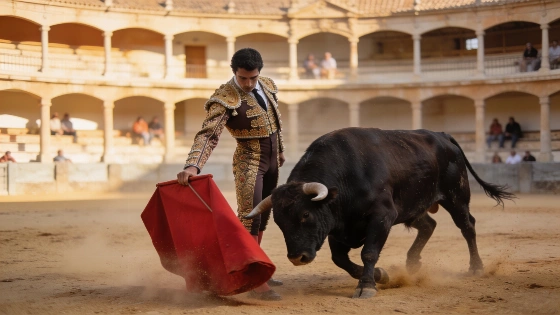
Roca Rey turned two difficult bulls into a double victory. Morante showed flashes of torería, while Tomás Rufo took one ear.
The Plaza de Valencia filled for the 9 October 2026 corrida, the central event in the city's 9 d’Octubre cycle. The advertised start time was 17:30, and the afternoon placed Roca Rey against an Álvaro Núñez string that offered little help.
The Peruvian matador left on shoulders after taking two ears. He won them through persistence rather than easy brilliance, carrying the afternoon whenever the bulls refused to do so.
The decisive work came with the second bull. Roca Rey opened with verónicas near the mouth of the watering trough, examined the animal briefly with the muleta, then dropped to his knees for passes behind the back and over the head. The bull never fully surrendered and faded, yet the matador kept the faena moving until the finish became a display of calculated danger.
The six-bull programme matched Roca Rey with Morante de la Puebla and Tomás Rufo against Álvaro Núñez stock.
The Valencia corrida was announced as Roca Rey’s final European appearance of the 2026 season; he was not expected to take part in the remaining Spanish fairs.
He stayed within inches of the horns, added circular passes and touched the knee at points, holding the crowd even when a helicopter's deafening noise crossed above the ring. Levante-EMV also described the National Police helicopter interruption during Roca Rey's work. The sword fell somewhat low, and an aviso came before the ear.
His second performance demanded a different kind of control. The fifth looked the most serious bull of the afternoon, but its opening sections showed complete mansedumbre. It fled from the muleta, kept watching the boards and resisted every attempt to leave them. Roca Rey used the cloth as a full screen, found partial obedience on the right, then imposed his ground and rhythm on an animal that never stopped preferring the tablas.
The result was command rather than delicacy. A sword while losing the muleta brought another ear and a second aviso.
That secured the grand exit. Advance coverage placed expected attendance at about 12,000 and reported a no hay billetes status. Álvaro Núñez had presented Morante and Roca Rey as genuine rivals whose competition could increase public interest in bullfighting. He called them two of the leading figures of the contemporary season.
À Punt showed the corrida live and free, opening a run of four consecutive days of bullfighting broadcasts from 9 to 12 October. The Valencia event itself formed part of the 9 d’Octubre programme running from 9 to 11 October, with each advertised performance beginning at 17:30.
Morante de la Puebla produced the afternoon's clearest flashes of torería, although neither bull gave him a clean platform. The first earned his opening ovation after a series of verónicas. Its right horn looked inviting at first, but the animal gawked and finished each pass with a jerk.
Morante's faena advanced in uneven steps. A left-handed structure led into two monumental naturales, followed by right-handed passes marked by depth, rhythm and compás. The estocada landed somewhat low, and the requested reward did not arrive.
The fourth gave him even less. Morante used faroles in the opening exchange and chicuelinas on the way to the horse, finishing with a serpentine turn. The performance ended there. The bull was uncast and dull, while the muleta attempts never found a solution.
After a hesitant killing, the audience still called Morante out to acknowledge the ovation. It carried the feeling of a farewell to this ring.
Tomás Rufo claimed the other ear with the third, a smallish colorado ojo de perdiz that reached the muleta showing marked mansedumbre and a clear desire for the boards. Rufo did not fight that preference. He kept the bull in the adentros near the toriles, then dominated it with authority.
Three slow and deep naturales formed the strongest passage. Closing manoletinas and a kneeled cambiado completed a performance built on control more than emotion.
The sixth offered nothing comparable. After a mildly obedient start, it stopped almost immediately, leaving Rufo's effort without result.
The lot comprised five bulls from Álvaro Núñez and a first from Torrealta. They were well armed but unevenly presented. The replacement and the final two looked more serious. The animals were generally short of strength, noble, low in race and notably tame in the fourth and fifth, while their work at the horse was serviceable.
The ceremonial frame mattered too. The afternoon began after the anthems of the Comunitat Valenciana and Spain. Public attendance was recorded as a full house of about 11,800 spectators, broadly consistent with advance estimates of roughly 12,000.
Earlier coverage of commemorations in Madrid had shown a similar public ritual, but attention in Valencia quickly moved from ceremony to the ring.
At the end of the bullfight, banderillero Javier Gómez Pascual cut his coleta. Morante's farewell-tinged ovation and Roca Rey's two ears gave the day its emotional outline.
The sporting balance was sharper. Valencia rewarded the man who solved the bulls rather than the bulls themselves. Roca Rey's triumph was substantial and hard-earned, while the limited caste left the matadors to supply nearly all of the intensity.
Levante-EMV independently described the Peruvian as the man who saved the celebration, confirmed his exit through the main gate after winning an ear, and noted the public's strong request for a second. A complete official protocol detailing every award, aviso and presidential decision was not available in the consulted reports.