Train service in central and northern Netherlands was brought to a halt after metal pipes were deliberately placed on the tracks. The incident forced emergency stops and widespread closures during rush hour. Police are investigating what they call an unprecedented act.
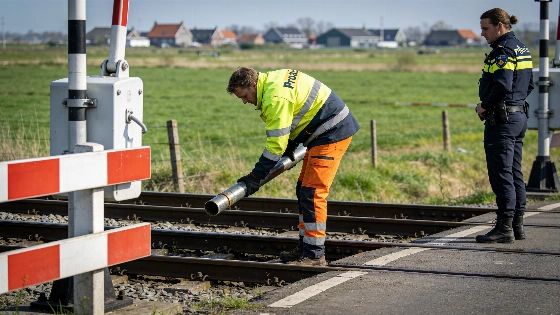
Train service across central and northern Netherlands stopped abruptly after authorities found metal pipes, some up to two meters long, wedged into the tracks. The sabotage triggered emergency systems, halting trains and closing level crossings, which left both rail and road traffic paralyzed during the morning rush.
At least 20 incidents were reported, with the most serious in Steenwijk, where a train struck one of the pipes. No one was hurt and the train stayed on the rails, but the event exposed a clear weakness in the Dutch rail network’s safety systems. The automatic alerts treated the pipes as if a train was already on the track, turning signals red and blocking all movement. ProRail, the infrastructure operator, said the materials were placed intentionally and the pattern of disruption points to a coordinated act, not isolated cases. This was confirmed by several independent sources, including Reuters and AFP.
According to DutchNews, the first safety inspections began around 5:30 a.m., with some lines, including those through Utrecht and Zwolle, being gradually reopened after the tracks were cleared.
ProRail confirmed the objects were attached on purpose. The disruption hit major junctions like Zwolle, Deventer, and Amersfoort, as well as key routes between Utrecht and Arnhem, Amersfoort and Deventer, and Apeldoorn and Deventer. The scale of the attack meant Dutch Railways (NS) could not provide replacement buses, given the number of affected routes and stranded passengers. ProRail recorded disruptions at at least 20 locations, with some reports mentioning up to 24, underlining the scale and likely coordination behind the sabotage.
Police have opened a criminal investigation, calling the sabotage unprecedented in the Netherlands. Evidence was collected from several towns, including Veenendaal, Deventer, Barneveld, Twello, Brummen, Putten, and Lunteren. Secretary of State Annet Bertram called the act "especially concerning." Rail traffic expert Rob Goverde noted that, despite the impact, the method was relatively simple. According to Reuters and AP, the motive and suspects are still unknown, and the investigation continues.
Images shown by NOS depicted pipes between 1.5 and 2 meters long jammed between the rails. The sabotage risked derailment and forced the closure of level crossings, worsening the disruption for road users. Some lines, such as Utrecht to Gouda, were gradually restored as teams cleared the tracks, but the morning’s chaos highlighted how easily interconnected transport systems can be disrupted. NS and ProRail said restoring train service was complicated by the number of affected sections, since each had to be checked and cleared by hand before trains could run again.
AFP and Reuters describe the incident as rare for the Netherlands, with ProRail emphasizing that this was a 'deliberate disruption' involving human intervention. The safety system responded to the foreign objects by treating the tracks as occupied, which triggered red signals and led to the closure of some level crossings, increasing road traffic congestion.
The effects reached neighboring countries. In Belgium, only one Eurocity train between Rotterdam and Brussels was cancelled, due to a track switch failure in Rotterdam. In France, authorities are investigating whether a recent derailment in Normandy, where a section of rail was found detached, could be linked to sabotage. French Interior Minister Laurent Nunez said no theory has been ruled out as the investigation continues.
While the Dutch incident stands out for its scale and coordination, it follows a pattern of recent disruptions in European rail networks. The investigation now extends beyond the Netherlands, with authorities in Belgium and France looking for possible links. Disruptions to critical infrastructure have previously caused major economic and social problems, as seen in other sectors reported earlier.
This attack shows that even advanced safety systems can be undermined by simple, targeted acts. The struggle to quickly restore alternative transport options points to a lack of resilience when facing deliberate disruption. As police search for those responsible and rail operators work to strengthen security, the incident is a warning for infrastructure managers across Europe. The Dutch case makes clear that sabotage is a real threat, and the cost of being unprepared is nationwide paralysis.