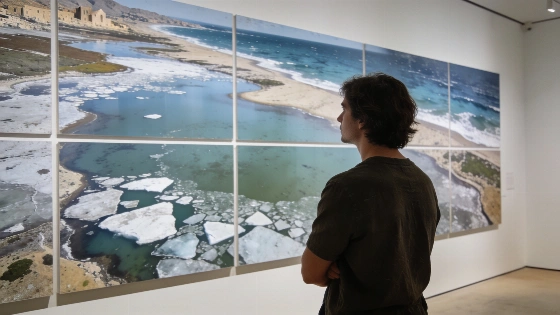
At CaixaForum Girona, satellite images connect polar ice loss, extreme rain and pollution with places people know. The exhibition asks visitors to look at environmental change from above, then consider its effects on the ground.
Miradas orbitales opened at CaixaForum Girona and will remain there until 9 February before travelling to other parts of Spain. Its images show the Earth altered by human activity in close detail. The message is direct. What happens far away can affect daily life.
Several displays tie distant processes to events in Spain. Visitors can compare the albufera de Valencia before and after a DANA. They can follow lava reaching the sea during the 2021 La Palma eruption. Another image shows the footprint of an open-cast copper mine in Sevilla.
During the recent extreme-rain episode in north-eastern Spain, the Mediterranean near the Spanish coast was reported to be about 3°C warmer than normal. That extra heat increases evaporation and the amount of moisture available to developing storms.
These are not abstract science displays. They show how floods, volcanic activity, land use and pollution change places where people live and work.
Michael Booth, the ESA coordinator for public outreach on Earth observation and data visualisation, referred at the opening to the torrential rains recorded in Catalonia in recent days. He said satellite observations show increasingly intense weather events in the Mediterranean. Some storms now resemble tropical systems more than the region's usual weather patterns.
Independent meteorological reporting described the episode as an organised mesoscale convective system, not an isolated thunderstorm. Such a system can sustain intense rain, hail and squalls. The term medicane is sometimes used for these events. It refers to a rare warm-core, quasi-tropical system, not a full tropical hurricane. Reports on this episode also said it did not begin as a classic DANA. Marion Friedl, project director at Ars Electronica, which designed the exhibition, shared that assessment.
Local rainfall totals in Barcelona were reported to reach as much as 200 mm. Spain’s AEMET weather service issued a special warning for torrential rain and very strong winds in areas around Barcelona and Girona.
The exhibition places climate change on a longer timeline. Older and current images reveal faster polar ice loss. Anna Ruiz, the scientific adviser to Miradas orbitales, said the effects do not stop at the poles. Changes in ice can affect ocean currents and the climate in many regions.
The Catalan rainfall episode shows the same link. Warmer Mediterranean water adds moisture to the atmosphere. Some assessments indicate that, under suitable unstable conditions, rainfall amounts can rise by roughly 20% for each additional degree of warming.
Space monitoring can also guide practical action. Satellite data can detect agricultural pests early. It can track the positive effect of protecting Indigenous territories from rainforest deforestation. The exhibition includes information on nitrogen dioxide, a gas linked to urban and industrial pollution that can cause respiratory problems.
One earlier analysis examined the wider link between snow and climate signals. It looked at how microplastics can reduce snow reflectivity and speed up melting in older snow near Formigal.
The route starts with the origins of satellites and their technological development. It then moves through the atmosphere, biosphere, hydrosphere and geosphere. Each section shows how human activity interacts with one of those layers. The images come from the satellite network of the ESA and the European Union. The accompanying data makes a vast stream of information easier for non-specialists to understand.
CaixaForum Girona director Anna Colomer said the format is aimed at adults and especially younger generations. Interactive maps and data help visitors connect satellite views with familiar situations. Parallel activities extend the programme.
One scheduled discussion will be led by Javier Martín, director of the Observatorio Fabra. It will focus on Earth observation from space and its value in anticipating risks and planning responses.
Booth also described open access to ESA images and data as a source of hope. Institutions and individuals can consult them from anywhere in the world.
That access matters. Miradas orbitales does not ask visitors to trust a distant promise about the climate. It gives them visual evidence and points to citizen science as one way to take part. CaixaForum Girona turns satellite observation into an accessible record of environmental change and an argument for protecting the planet.