A total solar eclipse will cross parts of Spain, Portugal, and Iceland. León and the northeast will see totality just before sunset. Most of Europe and North Africa will witness a dramatic partial eclipse.
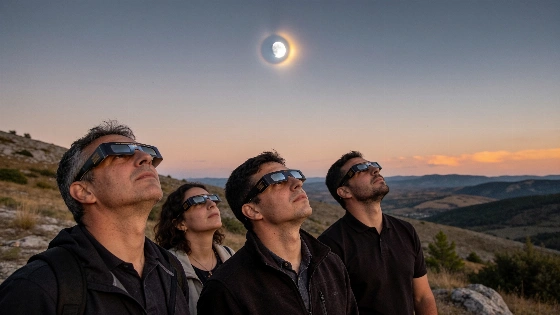
On Wednesday evening, Spain will become one of the few places in Europe to witness a total solar eclipse, with the phenomenon reaching its peak just before sunset in León and the northeastern tip of Portugal. According to NASA, the moon will fully obscure the sun for nearly two minutes in these regions, plunging the sky into darkness and creating a rare visual effect as the sun sets in eclipse. This event is expected to draw significant attention from both local residents and visitors, as the path of totality passes through northern Spain, Iceland, and a small area of Portugal.
Elsewhere, a partial eclipse will be visible across much of Europe, northwestern Africa, Canada, and the northern United States. The degree of coverage will vary: while New York will see only about 10% of the sun obscured, the United Kingdom will experience up to 95% coverage, a rare occurrence for the region. In Spain, the partial eclipse will linger after totality, with the sun setting as a crescent in many areas. The European Space Agency plans to broadcast a livestream from the Astrophysical Observatory of Javalambre in Teruel, and NASA will provide live coverage from across the eclipse path starting at 1:15 p.m. ET.
In León, totality is scheduled to begin at 8:28 p.m. local time and end at 8:30 p.m., while the partial phase will continue until 9:22 p.m. The longest duration of totality—about two minutes and 15 seconds—will occur in Greenland and Iceland during the late afternoon and early evening. For many in Spain, the eclipse will coincide with sunset, offering a unique view of the sun disappearing as a crescent below the horizon. Dr. Ryan French, a solar astrophysicist, has chosen to observe the event north of Madrid, prioritizing clearer skies over a longer totality experience.
Safety remains a priority, with experts urging the use of certified eclipse glasses or handheld solar viewers whenever the sun is visible, before, during, or after the eclipse. Observers are reminded that only during the brief period of totality is it safe to look at the sun without protection. The eclipse will begin with the moon taking a visible 'bite' out of the sun, progressing through partial phases that can last up to 80 minutes. As totality approaches, phenomena such as Baily’s beads and the 'diamond ring' effect will be visible, followed by the appearance of the sun’s corona—a faint, silvery glow around the moon. Depending on atmospheric conditions, including the presence of wildfire smoke, the corona may be more or less visible, and the sun may appear reddish, making it easier to photograph.
During the eclipse, spectators may also notice a drop in temperature, unusual animal behavior, and the sudden appearance of bright stars or planets like Venus. The chromosphere, a thin pink ring around the moon, may also be visible. After totality, eclipse glasses should be worn again as the sun re-emerges. For those interested in capturing the moment, some recommend recording the reactions of friends and family to preserve the experience.
Coinciding with the eclipse, the Perseids meteor shower will reach its peak between Wednesday night and Thursday morning, with NASA hosting a live watch party on YouTube from midnight ET on August 13. This rare overlap of astronomical events is expected to make the night sky particularly memorable for observers in Spain and beyond. For additional context on how Spanish regions are preparing for the influx of eclipse watchers and the measures being taken to ensure safety, see the detailed coverage on regional preparations for the eclipse in Catalonia.
Looking ahead, the next major total solar eclipse visible from Spain is expected on August 2, 2027, when the path of totality will cross southern Spain and several countries in North Africa and the Middle East, with totality lasting over six minutes in some locations. For now, Wednesday’s event offers a rare opportunity for residents and visitors in northern Spain to experience one of nature’s most striking spectacles.
For reference, a total solar eclipse occurs when the moon passes directly between the sun and Earth, casting a shadow that completely blocks sunlight in a narrow path. Partial eclipses, where only part of the sun is obscured, are more common but less dramatic. The last total solar eclipse visible from mainland Spain occurred in 2005, making this week’s event especially significant for astronomers and the public alike.